Tampilkan postingan dengan label Asian. Tampilkan semua postingan

Minggu, 22 Maret 2015

Marinated beef stir-fry with Savoy cabbage and cashews

You couldn’t tell by the recipes you see on this blog of mine, but I have a deep love for Asian cuisines; Chinese, Thai, Vietnamese, Indian, Japanese, Indonesian. I cook and eat dishes from these countries quite often and I’m not sure why my love for these cuisines is not reflected here. I will try to rectify that, however, and share with you my favorites.


When I was about seventeen, I became obsessed with Chinese food that was not particularly popular or widespread in Greece at that time. I bought cookbooks which were actually among the first cookbooks I have ever purchased, I persuaded my mom to buy me a wok and chopsticks, and my adventure in the kitchen began. Up until that time, I had learned everything about cooking from my family—my mom, my grandmother and grandfather—so this was the first time I was venturing out on my own and exploring other flavors, aromas and way of cooking. It was thrilling!


I was intrigued by the exotic ingredients, those I could find that is, and the unique flavors, and apart from the basic dishes I learned how to cook, like fried rice, stir-fries, noodles and spring rolls, I also taught myself how to eat with chopsticks. I never gave up until I learned how to use them properly, no matter how difficult it was for me, and I remember I ate every kind of food with chopsticks in order to practice. It was hilarious.


I used to invite my friends over for dinner to show off my skills and introduce them to Chinese cooking and they were so impressed. They found it delicious and I was so proud. I guess I have always had that deep-rooted need to feed people and see the satisfaction on their faces.


Then my obsession moved to the subcontinent of India and the intoxicating flavor of spices and herbs that were not so unfamiliar to me since my family’s style of Greek cooking (Politiki cuisine) is very much dependent on similar spices.


When I moved to Holland a few years ago, I discovered even more Asian cuisines, and since there’s a huge Asian community in The Hague, with shops that have everything I could ask for, I began experimenting and learning more about them. My love blossomed as I began discovering the Indonesian cuisine, very widespread here in Holland, as well as the Vietnamese and Malaysian.


I can safely say that I cook at least once a week an Asian or Asian-inspired recipe, and it’s about time I shared some of them here as well. This one is Chinese-inspired and based on the technique of stir-frying.


Beef, very thinly sliced, is marinated in a mixture of fresh, fiery, red chilli peppers, garlic, ginger, soy sauce and Chinese five-spice, and then is added to a piping hot wok and stir-fried. The majestic and beautifully deep green Savoy cabbage, cut into long strips, is added to the pan, along with some cashews and the juices of the marinade, and a few minutes later the dish is served with rice noodles and a good squeeze of lime. The zingy, bright, salty, sweet and spicy flavors blend to create a sumptuous and light dish with various and interesting textures.


Chilli and ginger-marinated beef stir-fry with Savoy cabbage and cashews
Adapted from Hugh Fearnley-Whittingstall

I discovered Savoy cabbage when I moved to the Netherlands; I have never seen it in Greece. You can substitute it with Chinese cabbage or kale if you can’t find Savoy cabbage where you live.

Stir-frying is a method of Chinese cooking where ingredients are fried quickly in very little oil in a hot wok and stirred continuously. To successfully stir-fry, it is crucial that you have your mise-en-place ready so that you don’t need to stop halfway through the cooking and chop or prepare an ingredient.

Use a tender beef cut like fillet, topside or top rump that doesn’t have fat or sinews, cut into thin strips as it will only cook for a few minutes.

Apart from rice noodles, you can also use egg noodles, soba (buckwheat) noodles, or rice.


Yield: 2 servings

Ingredients

for the marinade
1 fresh red chilli pepper, finely sliced (keep seeds if you don’t mind the heat)
1 large garlic clove, mashed or grated
2 tsp grated ginger
2 Tbsp soy sauce (I use low-sodium)
1 Tbsp rice vinegar
1 tsp Chinese 5-spice powder
1 Tbsp soft dark brown sugar

300 g lean beef (fillet, topside or top rump), cut across the grain into thin strips
50 g unsalted cashew nuts
4 large leaves (about 150 g) Savoy cabbage, central veins cut off
2 Tbsp sunflower oil
Juice from 1-2 limes
Salt

100-150 g rice noodles (cooked according to package instructions), to serve with the stir-fry

Special equipment: wok (or deep frying pan), colander


Preparation

In a medium bowl, add all the ingredients for the marinade and mix well with a spoon. Add the beef strips and mix well to coat with the marinade. Cover with plastic wrap and refrigerate for 45 minutes and up to 4 hours. The longer you have time to marinate the beef the better the flavor will be.


Heat your wok over medium heat. Without adding any oil, and once hot, add the cashews. Toast them, stirring frequently so they don’t burn, for about 2 minutes or until lightly browned. Remove them from the wok and onto a plate.

Stack the leaves of the cabbage one on top of the other and roll them up. With a large knife cut them into strips and place them inside a colander. Place colander in your sink, boil 1 liter of water in a kettle (or as much water as your kettle holds) and pour it over all over the cabbage to wilt it. Leave to drain.

Cook the noodles at this point, according to the packet instructions, and while they are cooking, heat the sunflower oil in the wok over high heat.


Remove the beef from the marinade, shaking it so the marinade drips off back into the bowl, and place it on paper towels to dry a bit. Reserve the marinade.
Add the beef to the hot wok and stir-fry it for about 2 minutes or until it has browned all over. Add the cabbage and the marinade juices to the wok and stir-fry for further 2-3 minutes. Add the cashews at the last minute.
Squeeze some lime juice on top, give it a taste and add salt if you think it needs it. Take it off the heat.
Plate the noodles and the beef with the cabbage in individual bowls.
Squeeze more lime juice on top if you want and eat straight away!


Senin, 11 Agustus 2014

Thai turmeric roasted chicken with lime-flavored Jasmine rice

Being with people you love, people you don’t get to see often because you live in different countries, having them live with you for a while, go on holidays together, enjoy them to the fullest, sharing food with them, food you have cooked for them, food they crave, seeing their faces light up with pleasure from what they are savoring, is a blessing.


They have brought with them from Greece ingredients and foods we have missed immensely, like pastourma, soutzouki, green olives, loukanika, cheese and tarama. I have been happily cooking in my hot little expat kitchen for all of us, making the best out of the ingredients, feeding our hungry bellies.


We had a small break from Greek food, however, to savor a differently spiced chicken dish. A Thai chicken dish flavored with turmeric that has become one of my favorites ever since I discovered it a little while ago.


Even though Thai cuisine is very complex, this dish is quite simple with unique and beautiful flavors. With heat coming from the white pepper and spiciness from the coriander seeds, sweetness from the palm sugar and saltiness from the nam pla (Thai fish sauce), freshness from the floral and aromatic coriander, with the crispy skin and the juicy flesh of the marinated and roasted chicken accompanied by a fresh, sticky, lime-flavored jasmine rice. The turmeric, apart from rendering a wonderful golden-yellow hue to the chicken, also adds a warm, zesty and earthy flavor that balances the sweet notes of the dish.


It’s effortless to make and utterly delicious, firing up your taste buds with every bite; ideal summer cooking.


Thai turmeric-marinated roasted chicken drumsticks
Adapted from Andrea Nguyen

You can use this marinade to flavor any other chicken piece. I have used it for breasts (skin on) and whole legs. I wouldn’t suggest you use it with skinless chicken as the flavor that will permeate its flesh will be too intense.


Yield: 4 servings

Ingredients

for the marinade
1½ tsp whole white peppercorns (or ground white pepper)
1½ tsp whole coriander seeds (or ground coriander)
2 tsp ground turmeric
1½ heaped Tbsp palm sugar (or soft dark brown sugar)
5 garlic cloves, peeled and roughly chopped
4 Tbsp fresh coriander stalks (or parsley stalks if you dislike fresh coriander), roughly chopped
2 Tbsp nam pla (Thai fish sauce)
1½ Tbsp oyster sauce

8 chicken drumsticks, skin on (about 1 kg in total)

2 limes, for serving

Special equipment: mortar and pestle or spice grinder, small food processor, plastic wrap, large roasting tray, pastry brush


Preparation

for the marinade
If you’re using whole white pepper and/or coriander seeds, grind them using a mortar and pestle or a spice grinder.
Add ground white pepper, ground coriander, turmeric, palm sugar, garlic, fresh coriander stalks, fish sauce and oyster sauce in the food processor and process until you have a somewhat smooth mixture.


In a large bowl, add the chicken drumsticks and pour the marinade over them. Mix well using your hands, taking care to rub it on and under the skin well.
Cover the bowl with plastic wrap or, alternatively, place the chicken pieces with the marinade in a plastic bag suitable for storing food and seal it. Allow the chicken to marinate for at least 45 minutes, or up to 2 hours. If you choose to marinate the chicken for more than 1 hour, place it in the refrigerator. Take it out of the fridge 20 minutes before you put it in the oven, to allow it to come to room temperature.

Preheat your oven to 190-200 degrees Celsius.
Place the marinated chicken in a roasting tray large enough to fit all the pieces in one layer and pour the marinade on top.


Place the pan on the middle rack of the oven and roast the chicken for about 40 minutes, until it takes on a golden brown color and the skin becomes crispy and caramelized. Also, if you insert a knife or skewer on the thickest part of the chicken pieces, the juices should run clear and not be reddish in color. Don't cook for longer because the chicken will dry out and become tough.

Take it out of the oven and using a pastry brush, take the juices from the pan and glaze the drumsticks with it. Make sure to stir the juices before glazing in order to mix all the caramelized bits with the more liquid sauce.

Serve with lime, squeezing it on top of each drumstick, and with some fresh coriander leaves. Pair with lime-flavored Jasmine rice (recipe below).


Lime-flavored Jasmine rice

It’s sticky and moist, intensely aromatic and nutty. In a nutshell, the best rice for the above Thai chicken.
I always make this rice following the 1:1¼ method of measuring. Which means that for every 1 cup of rice, I add 1¼ cup water. It works perfectly each time for me.


Yield: 4 servings

Ingredients
1 cup Jasmine rice
1 Tbsp sunflower oil
1¼ cup boiling water
½ tsp salt
Zest of 1 lime, grated

Special equipment: sieve, rasp grater


Preparation
Add the rice to a sieve and place it under cool running water. Rinse the rice until the water runs clean. Leave to dry for 5 minutes.

In a small saucepan, add the sunflower oil and heat over medium-high heat. When it starts to shimmer, add the rice and toast, stirring constantly with a spoon or spatula for 1 minute. Add the boiling water, salt and ¾ of the lime zest and stir well. Bring to the boil and turn heat down to low. Put on the lid and simmer for 12 minutes. Remove from the heat and leave with the lid on for a further 8 minutes. At this point, the rice should be cooked, tender and sticky. Using a fork, fluff up the rice, put the lid on and leave it to stand for 5-7 minutes, as it will continue to steam.

Serve immediately, sprinkling on top the rest of the lime zest, along with the Thai chicken.


Minggu, 13 Maret 2011

Back

Hi everyone. I'm back. And I would like to thank each and every one who sent me an email or wrote me a note, for your kind words. I really appreciate it. You guys are so sweet. And you know what? I missed you. I missed writing here. I missed coming to this space of mine.


It's been difficult this past month but I'm slowly making my way back to normalcy, if there's anything like that in life; normalcy. Anyway.
Just look at everything that's been happening around the world, like in Japan and in Yemen or Libya and you'll realize that life can be anything but normal.


This past week I have been back in the kitchen big time. I'm really craving things, mostly in the form of soups and all things spicy. Perhaps it's because of this winter, which insists on sticking around even though every person in the Northern hemisphere is sick of it and wishing for spring to begin already.


I have been making Dutch pea soup and the classic Greek chicken avgolemono soup on one hand and on the other I have been making Indian butter chicken and Indonesian beef satay, trying to keep my palate in shape and on its toes.


And then suddenly I stumbled upon a recipe by Yotam Ottolenghi which combined both of my latest obsessions, soups and spiciness, and one of my long-standing obsessions, lentils. A Thai coconut milk and red lentil soup with crispy fried shallots. This has swiftly become my favorite soup of this winter and why not spring too.


This soup is so flavorful and healthy and spicy and fresh and hot and aromatic and soothing and, did I mention hot? Well, it is a Thai soup after all. And Thai cuisine is one of the most spicy and hot cuisines in the world.


Apart from being spicy though, Thai cuisine is one of the most harmoniously balanced cuisines in terms of flavors and textures and one with great diversity due to the influence of the Chinese, Portuguese, Dutch, French and Japanese on the style of cooking.


The marriage of sour, sweet, hot and spicy notes is accomplished by the use of fresh herbs, coconut milk and oil, ginger and galangal, kaffir limes, lemongrass, spices and the notorious curry pastes. Jasmine rice is one of the most popular varieties of rice in Thailand and is served with most dishes, whereas vegetables form the foundation of the Thai meal.


Nam pla, which is the Thai fish sauce, is one of the basic ingredients in Thai cooking, the same as salt is to the Western world. Fish sauce is a pungent, salty sauce made from fermented fish and is used as a condiment in stews, curries and soups as well as a dipping sauce or a marinade.


Fried shallots, which I made to accompany this soup, are widely used in South-East Asian cuisine, especially Malaysian, Thai and Vietnamese. They are used as a garnish for stir-fries, curries, soups or fried rice and they are immensely delicious. I love every type of onion there is (and I'm not afraid to say it) but these fried shallots were the cherry on top of this piquant Thai soup. The combination is simply amazing and truly flavorsome. Give it a try and you'll see for yourselves.


Thai Coconut Milk and Red Lentil Soup with Crispy Fried Shallots
Adapted from Yotam Ottolenghi

If you want to turn this dish into a vegetarian one, just use salt instead of the fish sauce. That easy.

Kaffir lime leaves (fresh or dried) are a bit hard to find in some places (for example Greece) but there's no actual substitute for them. The best you can do if you can't find them is to add the zest of 1 lime for every 2 kaffir lime leaves.

Curry pastes are an integral part of Thai cooking. Curry paste is a finely ground or pounded (traditionally with a mortar and pestle) moist blend of fresh herbs, spices and vegetables, with the main ingredient being chillies.
This recipe calls for Thai red curry paste which you can find in Asian grocery stores. You can also try making your own, using this recipe.


Yield: 6 soup servings

Ingredients
250 g red lentils
45 ml sunflower oil
1 medium-sized onion (about 90 g), finely sliced
1 ½ Tbsp Thai red curry paste
2 lemongrass stalks, beaten and bruised slightly with the back of a big knife or a rolling pin
4 fresh kaffir lime leaves or 6 dried ones
950 ml water
250 ml coconut milk
Juice of 1 lime, freshly squeezed, plus some extra for serving (optional)
15 ml soy sauce
30 ml nam pla (Thai fish sauce) or salt (to taste)
15 g fresh coriander leaves, roughly chopped

6 Tbsp crispy fried shallots (see recipe below)

Special equipment: colander, immersion blender or regular blender


Preparation
Place the lentils in a colander and rinse them under cold running water.

Pour the oil in a large, heavy-bottomed pan and heat it over medium heat. Add the sliced onion, turn heat down to low, cover the pan and cook the onion for about 13 minutes, until it is completely soft. Be careful not to brown the onion.

Add the red curry paste and stir it around. Cook it for 1 minute and then add the lemongrass, the kaffir lime leaves, the red lentils and the water. Stir everything around, cover, turn heat up to high and bring to the boil.
When it comes to the boil, turn the heat down to low and simmer for around 15 minutes, until the lentils soften.

Take the lemongrass and kaffir lime leaves out of the pan and discard them. Using an immersion blender, blend the soup until smooth and velvety. If you don't have an immersion blender, ladle the lentils into a normal blender and blend the soup there. Then return it to the pan.

Add the coconut milk, lime juice, soy and fish sauce (or salt) and stir well. Place the pan back on the heat (medium heat) and just before it starts to boil, turn the heat off.

Taste the soup and adjust the seasoning by adding extra fish sauce or salt.

Serve the soup in individual soup bowls and top with fresh coriander leaves and/or some crispy fried shallots. Squeeze some extra lime juice on top of the soup to give it that extra zing.

The soup can be refrigerated for a day. Reheat it and enjoy it.


Crispy Fried Shallots

Fried shallots were a revelation to me the first time I made them. I loved them. There was a battle between caramelized onions and crispy fried shallots in my mind as to which is the best onion condiment, but the fried shallots won in the end.

You can try them as a snack or you can use them to top off a salad or a steak, and you can also use the oil you fried them in to sauté just about anything. The oil, which has been flavored by the shallots, will render a beautiful aroma and taste to whatever you choose to sauté.


Yield: about 2 cups

Ingredients
450 ml sunflower oil
160 g shallots (around 8 shallots)
1/8 tsp salt

Preparation
Slice the shallots thinly in rings and separate them into individual rings.
Spread them in a single layer on paper towels and leave them to dry for 30 minutes.

Pour the oil in a large skillet and heat over medium-high heat. Once it starts to shimmer, test it by dropping a shallot ring inside. It must immediately begin to fry but not burn.
Add the shallots, salt them and fry them for 6-7 minutes. You must keep an eye on them, moderating the heat if needed, because you don't want them to get burned.
After those 6-7 minutes, they should start to brown. Turn the heat off and leave them there for another minute or so, until browned and crispy.

Remove them with a slotted spoon and place them on paper towels to drain excess oil and cool.

You can use them immediately or you can store them in an airtight container in the refrigerator for a week.


Jumat, 03 September 2010

Flavors speak louder than words

When I first moved to Holland, there was a restaurant right down the street from where I lived and whenever I walked by, it was always packed with people who seemed to be having a good time and enjoying a pretty good meal. The aromas traveling outside the restaurant made me dizzy and a little weak in my knees. They were so inviting, so appetizing. They were titillating smells that made me crave whatever kind of food was being served inside.


Whenever I sneaked a peek to see what people were eating, I was looking at rice dishes with lots of vegetables and small meat skewers with dipping sauces, and knew it was some kind of Asian food. I didn't know exactly what though. I was intrigued and so was S but we never made the decision to have dinner there. Not until last summer when we finally had enough of speculating.


As I called to make a reservation, it dawned on me that I still didn't know what kind of food they were serving. So, I asked the surprised lady who picked up the phone and her answer was, "Indonesian". Indonesian? I had no idea what Indonesian food was. Was it super spicy? Was it like Indian food, anything like Chinese food, or was it like Thai? I had no clue but I was kind of excited.


And rightly so. The dishes we got served up were amazing and... hot. A collection of different small dishes that comprised of lots of rice with various sambals (spice relishes), hot curry sauces, marinated meat on skewers called satay alongside an array of hot and sweet dipping sauces, all kinds of vegetables, pickled or stir-fried, lumpia (pastries much like spring rolls), perfectly cooked fish dishes and the most delicious fruit desserts. I was experiencing a revelation and I couldn't believe what I was missing out on all this time. I absolutely loved those new flavors and couldn't wait to discover more things about Indonesian cuisine.


Indonesian cuisine greatly varies by region and combines many different influences from India, the Middle East, Europe and China. The Portuguese, the Spanish and later the Dutch who colonized Indonesia and traded the spices found there (like nutmeg and clove), brought with them from home ingredients like string beans and cauliflower as well as peanuts, chilies, tomatoes and corn from the New World (the Americas). All these ingredients were incorporated beautifully into the already rich diet of the Indonesians which of course included the almighty rice.


Rice is Indonesia's most important staple food and is usually fried, boiled or steamed. Fish and shellfish are of course eaten regularly since they can be found in abundance—Indonesia is a collection of about 18,000 islands. Red meat is eaten sparingly and mostly in the form of a curry or marinated and cooked on skewers (satay). Tofu and tempeh (a pressed soybean cake) are widely used in salads and soups, and coconut milk comprises and all-around thickening agent for sauces and curries and an essential cooking ingredient. Vegetables, herbs and spices are paramount in Indonesian cooking, with tamarind (a seed pod from the tamarind tree that has a sweet and sour flavor), lemongrass (looks like fat spring onions but has woodier stalks and has a sweet, subtle lemon flavor. It can be eaten whole, sliced or pounded to a paste), coriander, turmeric, cumin and galangal (a root from the ginger family) being among the most widely used. Relishes and sauces like sambal oelek (a hot chili-based sauce) and kecap or ketjap manis (sweet soy sauce) accompany most dishes in Indonesian cuisine.


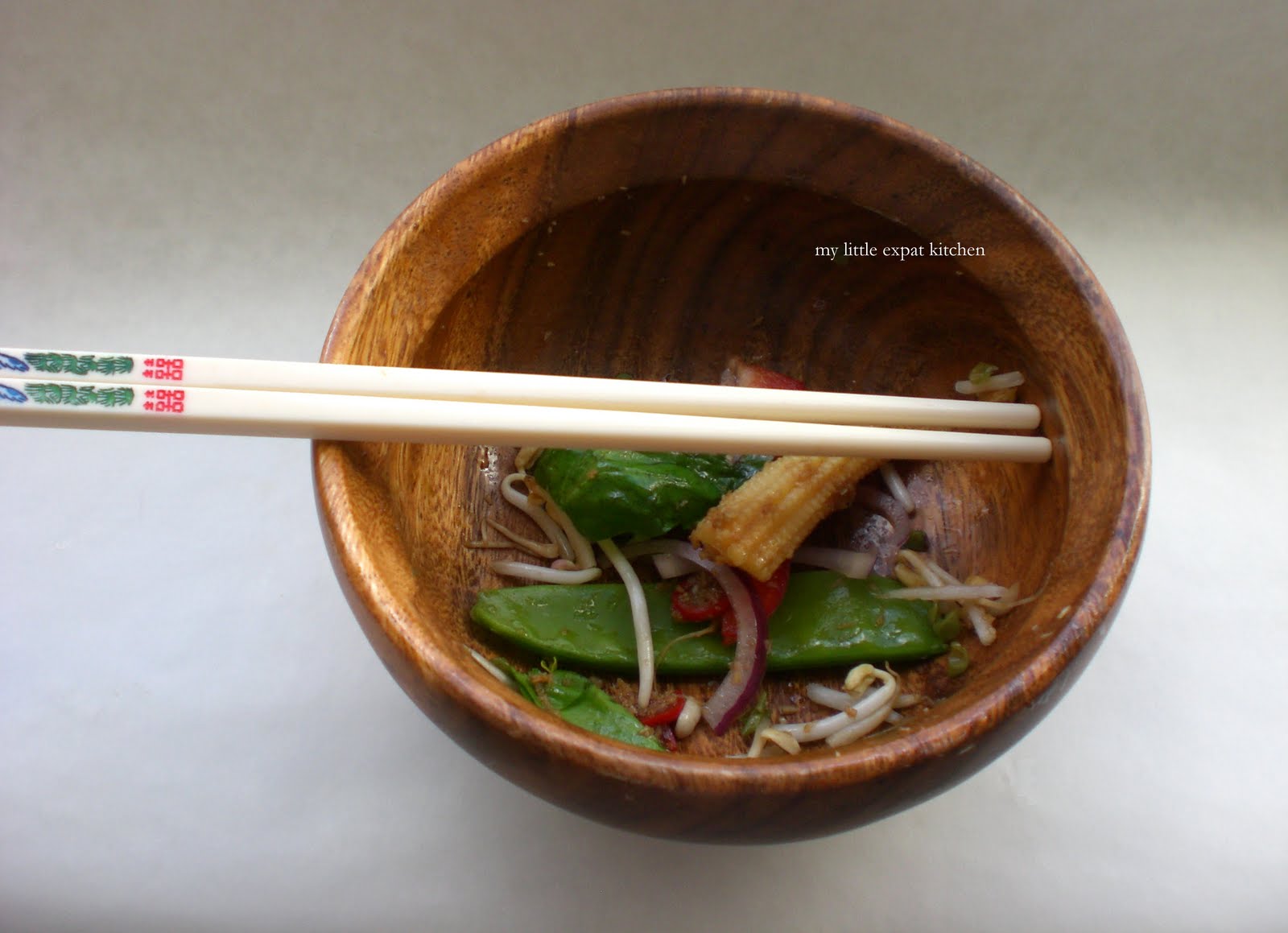
Indonesian cuisine is known for its deliberate combination of contrasting flavors and textures. This salad here is just that. A combination of perfectly balanced and flavorful ingredients with different textures. I love this salad. It's exotic, spicy, healthy, fragrant, hot, crispy and refreshing. It is all you need from a salad and then some.


All the vegetables, with their distinct, deliciously fresh and unique flavors make the salad extremely nutritious, fulfilling and a wonderful treat for vegetarians. The spice dressing adds heat and acidity as well as sweetness and earthiness to the dish. It is powerful and luscious and marries impeccably well with the crunchiness of the colorful vegetables. Serve this salad for lunch or a light supper, or serve it alongside an Indonesian main dish such as beef satay.


As I was draining the spinach, this little creature showed up out of nowhere... It's times like this that I wish I had a better camera


The first time I prepared this salad and put it down on the table, S glanced at it, then looked at me and said, "It is too raw for me". I replied, "It's a salad. They usually are raw". He was of course referring to the green beans and snow peas. Granted, the snow peas were raw but the green beans were blanched. That's hardly raw. And then he took the first bite. I knew he was instantly converted as I saw a smile appearing across his face. The next sound he made was a simple "mmmmm". Need I say more?


Indonesian Hot & Fresh Vegetable Salad with Spice Dressing
Adapted from The Essential Asian Cookbook

Those of you who are apprehensive about spicy or Asian flavors, please don't be. This salad may be hot and spicy but it is unbelievably fresh and delicious. In case you can't handle the heat of the chilies use less amount.

If you can't find brown rice vinegar (in Asian food stores) you can substitute with balsamic vinegar.
If you can't find snow peas (also known as mangetout) you can substitute with sugar snap peas.
You can either use fresh baby corn or canned baby corn in brine.
You can substitute peanut oil for corn or sunflower oil but the flavor of the dressing will be less authentic since peanut oil has a unique flavor.

This salad is totally adjustable to whatever bright-colored, crisp, fresh vegetables you have available. You don't have to restrict yourselves to the ones used here. Use carrots, cabbage, raw courgettes (zucchinis), cucumber, yellow or orange peppers and vegetables that you can blanch. Use your imagination and your own personal taste.

I would like to introduce a new page on my blog which is the "How-to and Tips" page. You can find a link here and at the right column of the main page. I have added some tips on how to handle chilies and I will be adding more tips along the way. I hope you'll find them helpful!


Yield: 4 main-course or 6 salad-course servings

Ingredients

for spice dressing
2 Tbsp peanut oil
1 large garlic clove, crushed
1 ¼ tsp fresh ginger, grated
½ long red hot chili or 1 small Thai red chili, thinly sliced (read this)
2 Tbsp desiccated coconut
1 Tbsp brown rice vinegar
80 ml (1/3 cup) hot water
1 Tbsp kecap manis* (optional)

for salad
300 g green beans
100 g snow peas (mangetout)
150 g baby spinach leaves
1 medium-sized red onion (80-90 g)
1 large red bell pepper (about 100 g)
100 g bean sprouts
7-8 baby corns
3 green onions, white and pale green parts only


Preparation

Make the spice dressing
Heat the peanut oil in a small saucepan over medium-high heat. Once the oil starts to shimmer add the garlic, ginger, chili and desiccated coconut. Lower heat to medium and stir-fry (fry by continuously stirring the ingredients around the pan) for 1 minute. Add the vinegar and water and simmer for 1 ½ minutes. Remove pan from the heat and add the kecap manis (if using). Allow the dressing to cool in the pan before adding it to the salad.


Prepare the salad

First of all you need to rinse all the vegetables thoroughly under running water.

Top-and-tail (cut off the ends of) the green beans and then cut them into 7-8 cm lengths. Boil 200 ml of water in a large pot over high heat. Once the water starts to boil, add the green beans and blanch them for 1 ½ minute. Drain them and let them cool.

Top-and-tail (cut off the ends of) the snow peas.

You can remove the stems from the baby spinach leaves if you wish, and if you're using larger spinach leaves you can slice them thinly.

Cut the red onion in half lengthwise and thinly slice it.

Cut the red bell pepper into thin strips.

Cut the green onions in an angle into 5 cm lengths.

Assemble the salad and serve
Combine all the vegetables in a large serving bowl and add the spice dressing on top. Toss until combined and serve.


*You can find kecap manis (Indonesian sweet soy sauce) in any Asian food store. If you can't find it and you want to add some extra sweetness to the dressing, you can add 1 tsp of dark brown sugar when you add the vinegar and water to the saucepan.