Tampilkan postingan dengan label chocolate. Tampilkan semua postingan

Kamis, 08 Januari 2015

Flourless dark chocolate and demerara sugar cake with pomegranate seeds (GF)


Happy New Year, friends. May 2015 be a healthy, joyous and lucky year for all, with lots of fun times and of course, delicious food.


I wanted to start off 2015 with a dessert that combined chocolate, my eternal love, and the pomegranate, a fruit that symbolizes luck, prosperity and good fortune in Greek culture; this one proved to be the ideal one.


It is a flourless cake with the rich, deep flavor of dark chocolate, some bitterness coming from the addition of freshly brewed espresso coffee, a hint of vanilla and the caramel-y flavor of demerara sugar that makes it particularly delicious.


Being not overly sweet, it welcomes the generous sprinkling of icing sugar that transforms its crackly top into a snowy landscape. The addition of the small, burgundy, sparkly jewels in the form of pomegranate seeds that decorate the top, adds another level of sweetness as well as an acidic undertone.


It is dense but not stodgy, almost like a fudgy brownie but much lighter, softer and far tastier, very moist with crackly, crispy top and edges, and with the plump pomegranate seeds giving extra crunchiness. Served with a generous dollop of freshly whipped cream sweetened with a little icing sugar, it is utterly scrumptious.


Chocolate and pomegranate is a beautiful combination and starting the New Year with these flavors was a choice that proved to be absolutely brilliant.


Let’s make this year a good one by being kind, generous and loving to ourselves and others. Let this be the year that all of our dreams come true.


Flourless dark chocolate and demerara sugar cake with pomegranate seeds (Gluten-free)

Demerara sugar is raw, cane sugar that gives desserts and cakes a special flavor and it is also healthier than white, refined sugar.

Use chocolate whose flavor you enjoy because the cake will taste very much like that chocolate. Make sure it is of good quality and I would suggest you don’t use a chocolate that has less than 70% cocoa solids.

If you don’t have an espresso machine, you can use a one-serving packet of espresso powder dissolved in 100ml boiling water.

I would strongly suggest you make the cake a day before you want to serve it as it is most delicious the next day.


Yield: 1 cake / 8-10 pieces

Ingredients
250 g unsalted butter, at room temperature, cut into pieces, plus extra for greasing the pan
250 g good quality dark chocolate (70% cocoa solids), cut into pieces
100 ml freshly brewed strong espresso coffee
1 tsp pure vanilla extract
1/8 tsp salt
180 g demerara sugar (raw cane sugar)
4 large eggs

Icing sugar, for dusting the cake
The seeds of 1 pomegranate

for the chantilly cream (to serve with the cake)
250 ml cream, full-fat (35%)
1 Tbsp icing sugar

Special equipment: stand mixer or hand-held mixer, springform round pan 22-23 cm, baking paper, baking tray


Preparation
Place the butter and chocolate in a heatproof bowl set over a pan of barely simmering water (bain-marie) and melt, stirring often with a spatula. The bottom of the bowl must not come in contact with the simmering water otherwise the chocolate will burn.
Remove the bowl from the top of the pan and add the espresso coffee, the vanilla and the salt and mix using a spatula. Set aside.

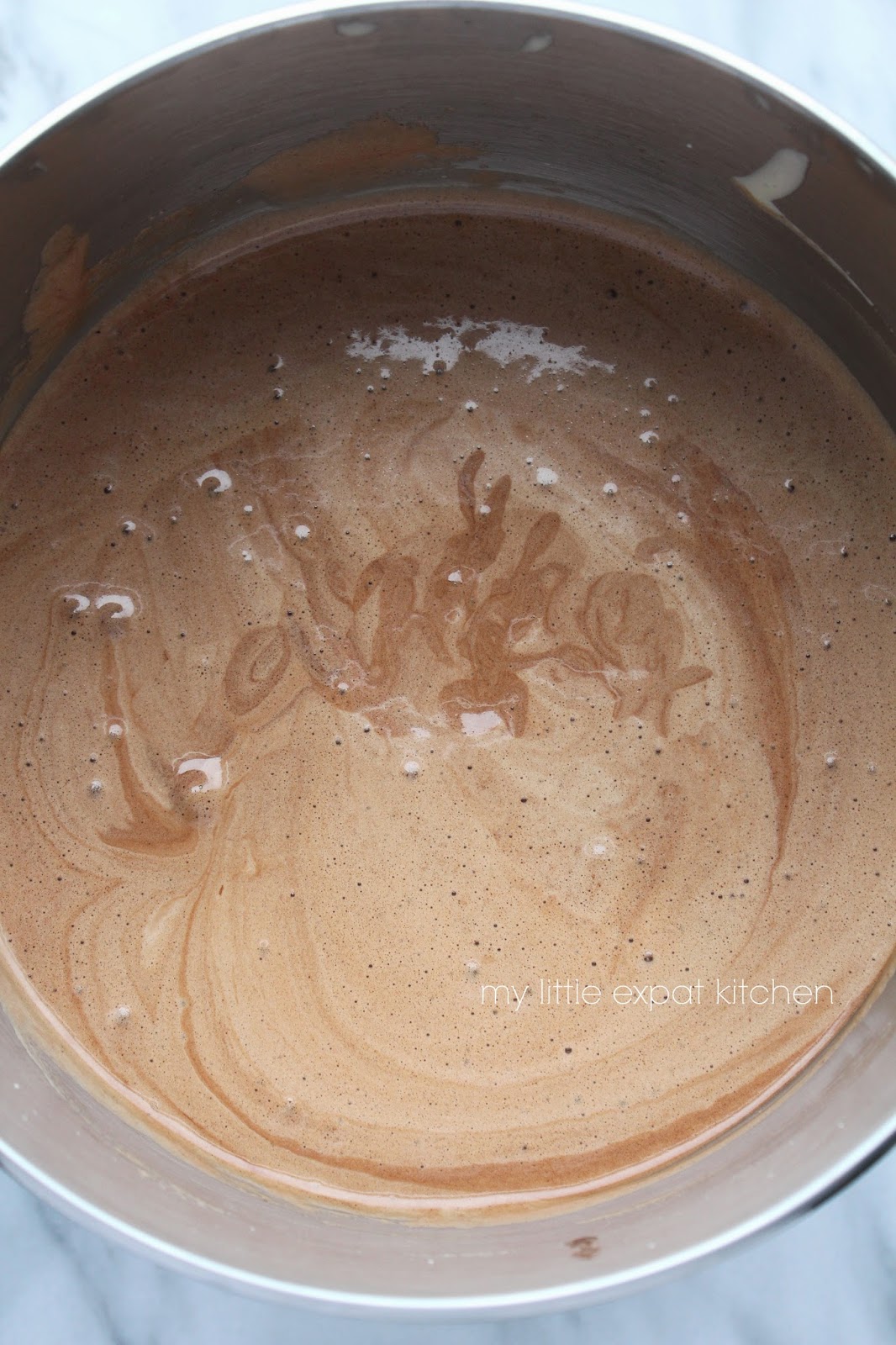
In the bowl of your stand mixer (or in a large bowl), add the sugar and eggs and beat using the whisk attachment (or with a hand-held electric mixer) on high speed, for 4-5 minutes, until the mixture reaches the ribbon stage (when you lift up the beater and let the mixture drip inside the bowl, you can see a ribbon forming on the surface and it stays for a few seconds before it disappears inside the rest of the mixture). The mixture should triple in volume and should be very light and fluffy.


In the meantime, preheat your oven to 175°C.
Butter the bottom and sides of the springform pan very well and line the base with a piece of baking paper (click here to see how to make a baking paper circle).

Pour slowly the chocolate mixture in the egg mixture and fold it in using a spatula, being careful not to deflate the eggs.
Empty the batter gently into the prepared baking pan. Place the pan inside a square baking tray to prevent any liquid (or butter) spilling out into your oven (you may want to line the baking tray with a piece of aluminum foil) and place on the low rack of the preheated oven.


Bake cake for 30 minutes, and then transfer it to the middle rack of the oven and bake for a further 10-15 minutes or until a wooden skewer or toothpick inserted in the middle comes out clean.
You will notice that during baking the cake will puff up and once you take it out of the oven it will sink and crack on top. That is perfectly okay, that’s how it should be.

Remove it from the oven and transfer the baking pan on a wire rack so that the cake cools completely. Don’t remove the sides of the pan while the cake is still hot, otherwise the sides will collapse. Run a knife around the edges of the cake to ensure that the cake is not stuck and then remove the sides of the pan carefully. You may serve the cake on the base of the pan or remove it. Be careful though because it may break.


Prepare the chantilly cream by whipping the cream and the icing sugar with a hand-held mixer or in a stand mixer until stiff peaks form. You can keep it in the fridge for 2 days, covered with plastic wrap.

When you want to serve the cake, dust it with icing sugar and decorate with the pomegranate seeds. Serve cut into pieces with a dollop of chantilly cream.

In case you have leftover cake, remove the pomegranate seeds from the top because they will make it soggy. Place seeds in a bowl and refrigerate them.
You can keep the cake covered, at room temperature, for 3 days.


Senin, 08 Desember 2014

Five years (and a few days) and a special dessert

Every year, around this time, I buy chestnuts, lots of them, to use in savory and sweet dishes or to eat them simply roasted on a cold evening. Chestnuts to me represent autumn and winter, yet this time I made something that I’d normally make during the summer. I made ice cream, chestnut ice cream.


I had a very specific dish in mind. I wanted to make a dessert, a somewhat special dessert for a special day in late November, which was the day this little blog of mine, this cherished part of the internet, turned five.


FIVE. I truly can’t believe I have been blogging for this long. I don’t think I’ve ever been this committed to anything for five years. It feels weird, yet fantastic. It feels like a huge accomplishment but I’ll be honest with you. This past year it’s been a struggle to keep up with this blog. The notion of giving it up crossed my mind and it was the first time I really did not care about it that much. I didn’t want to post as regularly, I wanted to keep things to myself more, live life without having to think about taking photographs of the food I cook or jotting down recipes with every little detail, and words didn’t seem to flow out of me as easily and as much as they used to.


However—and that is a big however—the fact that I found this anniversary worth celebrating, led me to the realization that I do still enjoy blogging, that I do enjoy this type of communication I have with you, the readers; those who quietly pass by, those who always leave a few words that make me feel that what I’m doing here is worthwhile and is being appreciated, those who send me emails with pictures of dishes they cooked from the blog, those who share their knowledge of food with me and who teach me new things, even those who are sometimes a bit harsh or abrupt in their comments; because I truly love creating recipes and sharing them here, with each and every one of you, and it brings me joy having you as my companions on this journey.


So, I had this idea to make a chestnut ice cream but then I thought, it’s winter, I want something else to break that icy feeling. I thought biscuit, and then sablé breton came to mind, a crumbly, sandy biscuit that’s not too sweet and has a light saltiness to it to add another dimension to the dessert. And then I wanted another component, like a sauce, chocolate of course, but with something else in it, to make things more interesting. Alcohol always works with chocolate and then I thought of Armagnac. The best.


A thick sauce that’s creamy, rich, and deeply chocolaty with a kick from the Armagnac, poured over the nutty and smooth ice cream that is cold but earthy at the same time, and the biscuit, that crumbly, buttery, crispy and slightly thick biscuit, adding another texture in the palate, creating a unique dessert. That was the dish I had in mind, and that’s what I made; a balanced and delicious dessert worthy of the five year anniversary of my blog.


So, happy birthday little blog. I really do love you with all my heart.
And thank you to all of you who have been following my adventures in the kitchen these past five years. Hope you join me for the next five to come.


And if you’re in the mood for more recipes with chestnuts, check out these recipes:
Sweet Chestnut Cream (Crème de Marrons)
Chocolate and Chestnut Truffles
Chestnut Cream Truffles
Chestnut Tiramisu
Chestnut Soup with Port
Chestnut Crêpes with Creamy Wild Mushroom Filling


Chestnut ice cream on sablés bretons biscuits with chocolate-Armagnac sauce

Sablés bretons are traditional French butter biscuits from the Brittany region.

You can easily serve this dessert after a festive meal during the Christmas holidays or on New Year’s as it’s so easy to make ahead; the biscuits can be made 1-2 days ahead, the ice cream 2-3 days ahead. The only component of the dessert I’d advise you to make on the day is the chocolate-Armagnac sauce. It is most flavorful the first day, but you can store it in the fridge for 3-4 days.

Also, you can just make any of the three components of the dessert for different occasions. The sablés make the perfect holiday cookies, the sauce can be served over poached pears or quinces for a quick desert, and the ice cream, well, it pretty much is perfect on its own.

The proportion of the biscuit, which is about 1.3 cm thick and 8-8.5 cm in diameter, works great for one large scoop of ice cream and for one serving. You can also cut out the biscuits smaller so you can have more portions of the dessert.


Yield: 8-10 servings

Ingredients

for the sablés bretons (makes 8-10 large biscuits, 8-8.5 cm diameter)
200 g all-purpose flour, plus extra for dusting
1½ tsp baking powder
Pinch of sea salt flakes (I used Maldon)
125 g caster sugar
3 large eggs yolks
150 g unsalted butter, cut into cubes and very soft

1 large egg yolk + 1 tsp cold water, for egg washing the sablés

for the chestnut ice cream (makes about 1 kg)
250 ml fresh, whole milk
250 ml cream, full-fat (35%)
½ tsp vanilla bean paste (or 1 tsp pure vanilla extract)
Pinch of salt
3 large egg yolks
50 g caster sugar
300 g sweetened chestnut cream (ready-made or homemade*) or chestnut jam

for the chocolate-Armagnac sauce (makes about 1½ cups)
170 g good quality dark chocolate (70% cocoa solids), chopped
80 ml cream, full-fat (35%)
1 tsp vanilla bean baste (or pure vanilla extract)
1/8 tsp sea salt
2 Tbsp Armagnac (or Cognac or brandy)
20 g (1½ Tbsp) unsalted butter, cut into very small pieces, at room temperature

*If you make my homemade sweetened chestnut cream, make sure to prepare it a day before you make the ice cream and keep it refrigerated.

Special equipment:
for sablés bretons — stand mixer or electric hand-held mixer, plastic wrap, rolling pin, baking sheet, baking paper, 8-8.5 cm round cookie cutter, pastry brush
for ice cream — heatproof spatula, fine sieve, plastic wrap, ice cream machine
for chocolate-Armagnac sauce — heatproof spatula


Preparation

for the sablés bretons
In a medium bowl add the flour, baking powder and sea salt flakes and mix with a spoon.

In the bowl of your stand mixer (or in a large bowl), add the sugar and 3 egg yolks and using the paddle attachment (or a hand-held electric mixer) beat on medium-high speed until light and fluffy, for about 2 minutes. Add butter little by little, beating well after each addition, until fully incorporated and you have a smooth mixture. Add the flour mixture and mix on low speed until a dough starts to form.


Lightly flour a clean work surface and empty the dough on top. Knead lightly to form a uniform dough, shape it roughly into a ball and then into a flattened disk, and place it between two sheets of baking paper. Using a rolling pin, roll it out 1 cm thick. Transfer it onto a baking sheet and place it in the refrigerator for 1 hour or until it is firm.


Preheat your oven to 180°C.

Prepare the eggwash by adding in a small bowl 1 egg yolk and 1 tsp cold water and mixing well with a fork.

Remove the dough from the fridge, remove the top sheet of baking paper and using a pastry brush, brush the top of the rolled-out dough. Using a fork, make a criss-cross pattern (see photo for reference) which is the traditional pattern for the sablés bretons.


Place baking sheet on the middle rack of the oven and bake dough for 6 minutes. Remove baking sheet from the oven and, using an 8-8.5 cm in diameter cookie cutter, cut 8-10 rounds and return baking sheet in the oven. (See photos for reference). Bake for further 8-9 minutes or until the dough is golden brown.
Remove from the oven and leave to slightly cool on the baking sheet for about 30 minutes. Then, using the same cookie cutter as before, carefully and cleanly re-cut the sablés and place them on a wire rack to cool completely.


Don’t throw away the small pieces of biscuit that you’ll be left with. Use them as a crispy topping for ice cream.

You can keep the sablés bretons at room temperature, in a cookie tin, for a week.

for the chestnut ice cream
In a medium-sized, heavy-bottomed saucepan, add the milk and cream and heat over medium-low heat until tiny bubbles appear around the edges of the pan, being careful not to boil the mixture.
In a medium bowl, add the eggs yolks and sugar and whisk well with a wire whisk until light and smooth.
Very slowly, pour the warm milk and cream mixture into the egg mixture, whisking quickly and continuously so the eggs don’t curdle. Pour mixture into the saucepan and heat over medium heat, stirring constantly with a heatproof spatula, making sure to keep scraping the bottom of the pan. Stir the mixture until it thickens and coats the spatula, for 5-6 minutes.

Pour the custard through a fine sieve and into a clean bowl. Add the vanilla bean paste (or extract) and salt and stir well. Leave to cool for about 30 minutes and then add the sweetened chestnut cream or chestnut jam and mix with a wire whisk to incorporate. Cover the bowl with plastic wrap and place in the refrigerator for about 2 hours or until the mixture is cold.


Empty the mixture into your ice cream machine and churn according to the manufacturer’s instructions.
Once the ice cream is ready, empty it into a container suitable for the freezer and freeze it for at least 4 hours before serving.

for the chocolate-Armagnac sauce
Place the chopped chocolate in a heatproof bowl set over a pan of barely simmering water (bain-marie) and melt, stirring often with a spatula. The bottom of the bowl must not come in contact with the simmering water otherwise the chocolate will burn.

In the meantime, in a small pan, add cream and heat over low heat until bubbles start appearing around the edges of the pan.

Once the chocolate is smooth and melted, turn heat off so the water stops simmering underneath, but do not remove the bowl from the top of the pan so it stays warm. Immediately add to the melted chocolate the heated cream along with the vanilla, the salt and the Armagnac, and stir well with the heatproof spatula to incorporate until you have a smooth sauce.
Add the small pieces of butter one by one, whisking with a wire whisk continuously to incorporate each piece into the sauce before adding the next piece. This will ensure that the mixture won’t split. You should end up with a smooth, shiny and somewhat thick chocolate sauce.

Empty it in a bowl and if you plan on using it on the same day, keep it at room temperature. If you plan on using it the next day, cover it well with plastic wrap and place it in the fridge. You can reheat it in a bain-marie or in the microwave, being careful not to burn it.
You can keep it in the fridge for 3-4 days but it has the best flavor on the day you make it.

assembling and serving the dessert
When you have all the components of the dessert ready, start assembling your dessert.
In individual plates, place one sablé breton biscuit. On top, add a large scoop of chestnut ice cream and then either serve the chocolate sauce on the side, in a small container, or pour the sauce over the ice cream.
Serve immediately.

Enjoy!!