Tampilkan postingan dengan label pasta. Tampilkan semua postingan

Minggu, 05 April 2015

Wild asparagus tagliatelle with lemon, olive oil and garlic

It’s that time of the year, when you go to the market and it’s filled with all possible shades of green. Vegetables I have missed seeing and tasting are popping up left and right and it’s impossible to choose what to take home with me.


Artichokes and spinach, dandelions and nettles, chard and peas, they are all there, even the first rhubarb of the year with its seductive reddish color to break the green monotony.


When I caught a glimpse of some wild asparagus hiding in the corner of one of the market stalls, I was drawn to them like a moth to a flame. I jumped and grabbed them before anyone else could, put them in my bag and didn’t think twice about getting anything else. They were all I wanted.


I bought more than we could eat in one meal, so I used them in a couple of different recipes. One of them was this tagliatelle with garlic, olive oil and lemon. It couldn’t be simpler really, because when you have fresh, in-season and rare ingredients like wild asparagus, you must treat them with respect and great care. You definitely shouldn’t fuss around too much with them or pair them with ingredients that will mask their flavor, but with ingredients that will complement and highlight it.


This light, healthy and fresh pasta dish was perfect, with the slightly bitter flavor of the slender wild asparagus—bitter flavor gets a bad rap, we need more bitter foods!—with the lemon brightening the dish up and the parmesan adding umaminess and dairy acidity.


If you can find wild asparagus, this is the dish to try. Well, this and the one I will be sharing in a few days. Stay tuned.


Wild asparagus tagliatelle with lemon, olive oil and garlic

I am aware that wild asparagus are not widely available in every country, so if you like the idea of this asparagus pasta dish but you can’t find wild ones, simply substitute them with an equal amount of tender, young green asparagus spears. However, you will need to blanch the regular green asparagus for 2-3 minutes before using them in the dish as they are far tougher than the extremely thin wild ones. Wild asparagus have half the thickness of a pencil.


Yield: 2 servings

Ingredients
200 g dried tagliatelle
200 g wild asparagus
2 Tbsp olive oil, plus extra for drizzling
1 garlic clove, minced
2½ Tbsp freshly squeezed lemon juice
Salt
Freshly ground black pepper
Parmesan, grated

Special equipment: colander, grater


Preparation
Rinse the asparagus under cold running water and snap off the woody parts at the bottom end. In order to do that, take the end of the asparagus between your thumb and forefinger, holding the top half with your other hand, and bend it until it snaps. It will automatically snap at the part where the woody part ends and the tender part starts. This snapping point will be lower or higher depending on the spear.
Cut the asparagus in half if they are too long.

Bring a large pot of salted water to the boil over high heat and add the tagliatelle. Cook until al dente (firm but not very hard) or cook to your liking.

While the water is boiling and the pasta is cooking, prepare the asparagus “sauce”. You will need to add some of the pasta water to the asparagus so keep that in mind.

Heat 2 Tbsp olive oil in a large, wide sauté pan (one that will fit the pasta as well) over medium heat and add the garlic. Sauté for a few seconds and add the asparagus. Season with salt and pepper and sauté for a couple of minutes, stirring gently and frequently. Add the lemon juice and keep sautéing the asparagus for one more minute. Add a little less than ¼ cup of the pasta water and cook asparagus until tender but not too soft. You want them to have texture and not turn into mush.

When the tagliatelle are ready, lift them from inside the pot using tongs, allowing the excess water to drain back into the pot, transfer them to the pan with the asparagus and toss gently to mix.

Serve immediately on individual plates, drizzle with some olive oil and grind some black pepper on top. Finally, grate some parmesan and sprinkle it over the top.


Minggu, 08 Maret 2015

Tortiglioni with purple broccolini, ricotta and lemon zest

I used to write a diary, where I kept all my inner thoughts and deepest secrets that I didn’t want anyone to know about and it has been that way sometimes here too; I have written things here that I haven’t even talked about with actual people. Blogging does that to you. It fools you into thinking that you are writing your personal journal intended for your own eyes only.


There have been times when I have written long blog posts that after reading them a second time, they felt too personal, too much information given that I wasn’t sure I wanted to share with the world and so were kept unpublished. And then there are other times when words are so difficult to come out of me that I can hardly formulate a single sentence worth publishing. It is tricky this blogging thing, still after five years, perhaps because of these five years. Finding a balance between what you want or don’t want to say is complicated.


Someone told me the other day that it’s not important if anyone reads my blog as long as I enjoy writing it. I had a different opinion but I didn’t share it with her because firstly, I am convinced she has never read my blog and secondly, because I believe she wouldn’t get it. If I did it just for myself, I wouldn’t be writing a blog, but said diary. I believe this applies to all bloggers.


Truth is, I enjoy the feeling that someone out there is reading what I have to say, makes a recipe I have shared, enjoys looking at my photographs, feels something because of what they find here. When I started this blog, I realized there were things to be said, things to be shared, not necessarily heavy stuff but everyday realities and stories about food and life in general. Before starting this blog I never thought anyone would want to read what I had to say. Some people do, though, and I want to thank them. Thank you.


I myself rarely follow a food blog whose author I can’t relate to or am unable to get to know them through their blog. I don’t follow blogs just for recipes but for the person behind those recipes. I want to know them a little, know what they are like as human beings, get a glimpse into their lives a bit. Not every blog post has to be a bearing of their soul, I'm not implying that, but they have to be able to give something. That’s why I never understood why any blogger would leave a comment on my blog without leaving their names too. It’s not about simply leaving a comment but trying to connect in some way, and you can’t do that without being open. Perhaps I’m being romantic but that’s how I see it.


So this food blogger cooked something and finally had time to photograph it. A simple pasta dish yet extremely tasty and satisfying. I found purple broccolini at the market and I couldn’t help but put a bunch in my basket. The idea of this pasta dish was born right then and there.


The broccolini were blanched and then quickly sautéed in olive oil and garlic, the tortiglioni were cooked al dente and gently dropped into the same pan. Ricotta was added to create a smooth “sauce” along with some of the pasta water, lemon zest for freshness and sharpness, and a good grating of Grana Padano for the salty and oumami flavor. It was a delicate pasta dish that smelled of spring.


Tortiglioni with purple broccolini, ricotta and lemon zest

You can also use rigatoni or penne rigate instead of tortiglioni. Also, if you’re in Greece, you can use anthotyro insetad of ricotta.

Broccolini (or bimi in Dutch) is a hybrid of broccoli and Chinese broccoli. It is extremely popular in The Netherlands and has become one of my favorite vegetables. There is a green and purple variety and their flavor is similar to that of broccoli but sweeter, milder and more tender.
You can substitute with purple sprouting broccoli (scheutjesbroccoli in Dutch) or green asparagus. Now is also the season in Greece and all the Mediterranean of wild asparagus, so if you can find it use it! Also, you can cut the small florets of a regular broccoli and use it in this recipe instead of the broccolini.

Update 22.03.2015: My mom found broccolini at one of Athens' open markets, so they can be found in Greece!


Yield: 2 generous servings

Ingredients
200 g (12-13) purple broccolini
250 g tortiglioni pasta
5 Tbsp extra virgin olive oil
1 garlic clove, mashed or grated
200 g fresh ricotta cheese
Zest of 1 lemon
Salt
Freshly ground white pepper
Grana Padano (or Parmesan), freshly grated

Special equipment: grater, colander


Preparation
Fill a large pot with water, add salt and place it over high heat. When the water starts to boil, add the broccolini and blanch for 2-3 minutes, until the stems are almost tender. Remove the broccolini with a slotted spoon and into a colander to drain and cool a bit. Don’t discard the water! When cool, cut the broccolini in half if they are too long.

Place the pot back on the heat and bring the water you used to blanch the broccolini to the boil. Add the pasta and cook until al dente or to your liking.

In the meantime, in a large, wide sauté pan (one that will fit the pasta as well) add 4 Tbsp of the olive oil and heat over medium heat. Add the garlic and sauté for a few seconds, being careful not to burn it. Add the broccolini and sauté for 2-3 minutes. Do not toss the broccolini too much or the florets will break up. Season with a little salt and white pepper.

At this point, the pasta should be cooked. Take a cupful of pasta water and reserve it. Using a slotted spoon, transfer the pasta to the broccolini. Add the ricotta to the pan and a little of the pasta water, grate the lemon zest directly over the pan so that the oils of the lemon fall in the pan, and mix gently all the ingredients together, being careful not to break up the broccolini. Check the consistency and add more pasta water in order to have a creamy “sauce”.
Drizzle with 1 Tbsp olive oil and serve immediately in plates.
Grate as much Grana Padano on the top and enjoy!


Sabtu, 22 November 2014

Fettuccine with fresh porcini mushrooms and crème fraîche

The best type of dinner is the one I can prepare quickly and not in the sense that I want to get it over with, even though sometimes that is the case, let’s not kid ourselves, but in the sense that there’s a certain satisfaction in cooking and eating something that’s special in less than half an hour.


I love this kind of meals during a busy workday when my energy levels are low and I can’t possibly bring myself to cook anything that requires too much of my attention or time, or on a Sunday when S and I have the whole day to ourselves and I don’t wish to spend too much time in the kitchen but rather at the dinner table with a glass of wine, some beautiful food and my partner’s company.


This is how this creamy fettuccine dish was created last Sunday; with the glorious porcini mushrooms, the kings of the mushrooms, crème fraîche and parmesan, shallots and garlic and some semi-sweet wine.


The earthy, nutty aromas that emanated from the pan while I was sautéing the porcini, tricked me into thinking I was cooking some sort of meat rather than mushrooms and led me to the realization that if I could have fresh porcini on a regular basis, I would consider becoming a vegetarian. Perhaps.


The crème fraîche added acidity to the dish, without masking the umami flavor of the mushrooms, whereas the salty parmesan took away the sharp edge from the crème fraîche, and the woody thyme added freshness. With a glass of semi-sweet white wine, it was a pretty special, and quick, Sunday meal.

PS. Last night I watched this movie and it was sweet and light and full of marvelous food, aromas and flavors. You have to watch it!


Fettuccine with fresh porcini mushrooms and crème fraîche

If you can’t find fresh porcini, use fresh chanterelles or girolles or any other wild mushrooms you can find.

Don’t wash or rinse the mushrooms because they will soak up all the water and lose their flavor; just scrub them lightly with a soft brush all over to get rid of the dirt. There are special mushroom brushes that you can use, but if you don’t have one, you can use a very soft, unused toothbrush.

You don’t want to cook the porcini to oblivion because you want them to retain that springy and delicate texture. Their meaty yet subtle flavor will shine through but you mustn’t overwhelm them with too many ingredients. You want to complement their flavor not overpower it.


Yield: enough for 2 hungry people

Ingredients
250-300 g dried fettuccine
4 Tbsp extra virgin olive oil
1 shallot, minced
200 g fresh porcini mushrooms, brushed and sliced thickly lengthwise
1 garlic clove, minced
100 ml semi-sweet white wine
150 g crème fraîche, full-fat
2 fresh thyme sprigs, leaves picked
Salt
Freshly ground black pepper
Parmesan, grated

Special equipment: colander, mushroom brush (optional), cheese grater


Preparation
Bring a large pot of salted water to the boil over high heat and add the fettuccine. Cook until al dente (firm but not very hard) or cook to your liking. Reserve about 60 ml (¼ cup) of the pasta water and drain the fettuccine in a colander (but don’t shake the pasta), discarding the rest of the water.

While the water is boiling and the pasta is cooking, prepare the sauce.

Heat 2 Tbsp olive oil in a large, wide sauté pan (one that will fit the pasta as well) over medium heat and add the shallots. Sauté for 2-3 minutes until they become translucent and very soft. Empty shallots and oil into a bowl, wipe the pan with some kitchen paper and heat the pan again over medium-high heat.
Lay the porcini in one layer in the pan and dry them out i.e. cook them until they release their juices and the juice evaporates, for a few minutes on each side, being careful not to burn them; moderate the heat so it’s not too high.

Season the porcini with salt and black pepper, add the garlic and 1 Tbsp olive oil and continue to fry on medium-high heat for about 1 minute. Return shallots and oil to the pan and mix well. Then deglaze with the wine. Oh the aroma! Scrape any bits that have stuck to the pan, that’s the good stuff!

Add the crème fraîche and some fresh thyme leaves, stir gently and leave to incorporate into the sauce over low heat. Add a little pasta water to thin the sauce out a bit if it’s too thick and add one last Tbsp of olive oil.

When the pasta is ready, add it to the pan and mix with the sauce.
Sprinkle with some more black pepper, the rest of the fresh thyme leaves, lots of grated parmesan and serve immediately.


Rabu, 30 Juli 2014

Rigatoni with white wine-braised artichokes and peas

Last Tuesday was my name day and we had way too many watermelon and cantaloupe daiquiris, splurged on good sushi and ate one of the best chocolate ice creams I’ve ever had as well as some chocolate ganache tartlets for good measure.


The rest of the week was a bit of a blur. I cleaned the house top to bottom in the middle of yet another mini heatwave (don’t you hate cleaning in the summer?), because we have house guests coming in a few days and they are not used to our mess. Yes, we are messy. I so admire and envy those tidy people who keep their house instagram-ready at all times.


I went shopping, stocking up on things for our guests, for the house, pour moi, and I slept like a log. This heat is making me feel tired all the time and I want to go to sleep from the moment I wake up.


I cooked, just barely, and only because S started complaining about all the raw salads and sandwiches we’ve been having lately. Well, can’t blame him, but you know, in the daily match of heat versus kitchen, heat wins. Truth be told, I was craving something more substantial too, and I also missed sitting down to a proper dinner.


I found some good artichokes at the market and the idea of this pasta dish was born. It was a little summer miracle, even though I had a bit of a hard time with the fresh artichokes that took twenty minutes to clean, but they were so beautiful I couldn’t resist them.


I had capers from Santorini in my fridge, peas in my freezer, a packet of rigatoni in my cupboard and a bottle of Sauvignon Blanc. The dish was absolutely delicious, fresh, and light, with sweet flavor from the peas, meaty, slightly bitter taste from the artichokes, with saltiness from the plump capers and vibrancy from the wine. Overall, a harmonious, lovely, summery pasta dish.


Rigatoni with white wine-braised artichokes and peas, with capers and lemon

Naturally, fresh peas will be even better than frozen as they’ll be sweeter.
If you’d rather not spend your time peeling and cleaning fresh artichokes, use frozen artichoke hearts bearing in mind that they will need more cooking. However, fresh artichokes have a superior flavor. Just sayin’.


Yield: 4 servings

Ingredients
4 fresh globe artichokes, about 300 g each
1 lemon (to use for cleaning the artichoke)

3 Tbsp olive oil
2 shallots, finely chopped
2 garlic cloves, finely chopped
120 g frozen peas
Grated zest of 1 lemon
250 ml dry white wine (I used Bordeaux Sauvignon Blanc)
2 Tbsp capers, rinsed and drained
Salt
Freshly ground black pepper

A handful of fresh parsley leaves, finely chopped
Parmesan, grated
Olive oil, for finishing
Juice of ½ lemon

400 g rigatoni pasta

Special equipment: grater, colander


Preparation

Peel and clean the artichokes
Fill a large bowl with water halfway and add the juice of 1 lemon. Keep the lemon cups.
Take each artichoke and peel off the leaves, starting from the bottom. Remove all the leaves, including the soft purple ones in the middle. Then remove the hairy choke scooping it out with a spoon. Using a lemon cup, rub well the artichoke center. This will protect it and it will not turn black. With a knife, cut around the artichoke heart in order to remove the hard base if each leaf you have removed and cut off the stem. Rub the artichoke again all around with the lemon cup and place it in the bowl of water and lemon juice.
Continue cleaning the rest in the same way.


In a large, wide, heavy-bottomed pan, add the olive oil and heat over medium heat and add the shallots. Sauté, stirring often until they begin to color, then add the garlic and sauté for 1 minute, being careful not to burn it.
Take each cleaned artichoke, cut it into strips (4-5 strips each) and add it to the pan along with the frozen peas, a little salt and pepper, and the lemon zest and sauté for a couple of minutes.
Add the wine, allow it to come to the boil so the alcohol evaporates and turn heat down to low. Put on the lid and simmer, stirring every so often, until the artichokes have softened bur remain al dente. You don’t want them to become mushy. They’ll take about 25 minutes. Five minutes before the artichokes are done, add the capers and stir well.


In the meantime, while the artichokes and peas are cooking, prepare the pasta. Bring a large pot of salted water to the boil over high heat and add the rigatoni. Cook until al dente (firm but not very hard) or cook to your liking. Reserve about 60 ml (1/4 cup) of the pasta water and drain the rigatoni in a colander (but don't shake the pasta), discarding the rest of the water.

When the artichokes are ready, add the drained rigatoni to the pan. Add the lemon juice, half of the parsley, a little pepper and a good grating of parmesan and toss well to mix. If it’s dry, add some of the pasta water to the pan and toss again.

Serve immediately in individual plates. Sprinkle with the rest of the parsley and grate parmesan on top. Drizzle with a little olive oil to finish (and a little extra lemon juice if you wish).


Kamis, 19 Juni 2014

Shells

We’ve been watching the World Cup non-stop since it started last week. I’m beginning to have dreams about it, no kidding. It’s not that S is such a football fanatic that he makes me watch every game, it’s that we are both excited to watch. The matches are so damn good.


When it is at the level of the World or European Cup, then football is impressive and skillful and you can witness true magicians of the sport doing their thing. I am quite the fan!


The Netherlands has already won two matches but my country’s team, Greece, lost unfortunately (yet understandably). I was annoyed and bummed out about it, however tonight they’re playing again so let’s hope for the best.


Apart from all the football watching, working, daydreaming about our holidays and life in general (I tend to do that often), I have been doing some cooking as well. Mostly easy savory dishes and desserts since I’m pressed for time, nevertheless a couple of days ago I made one of S’s favorite dishes that’s a little more elaborate.


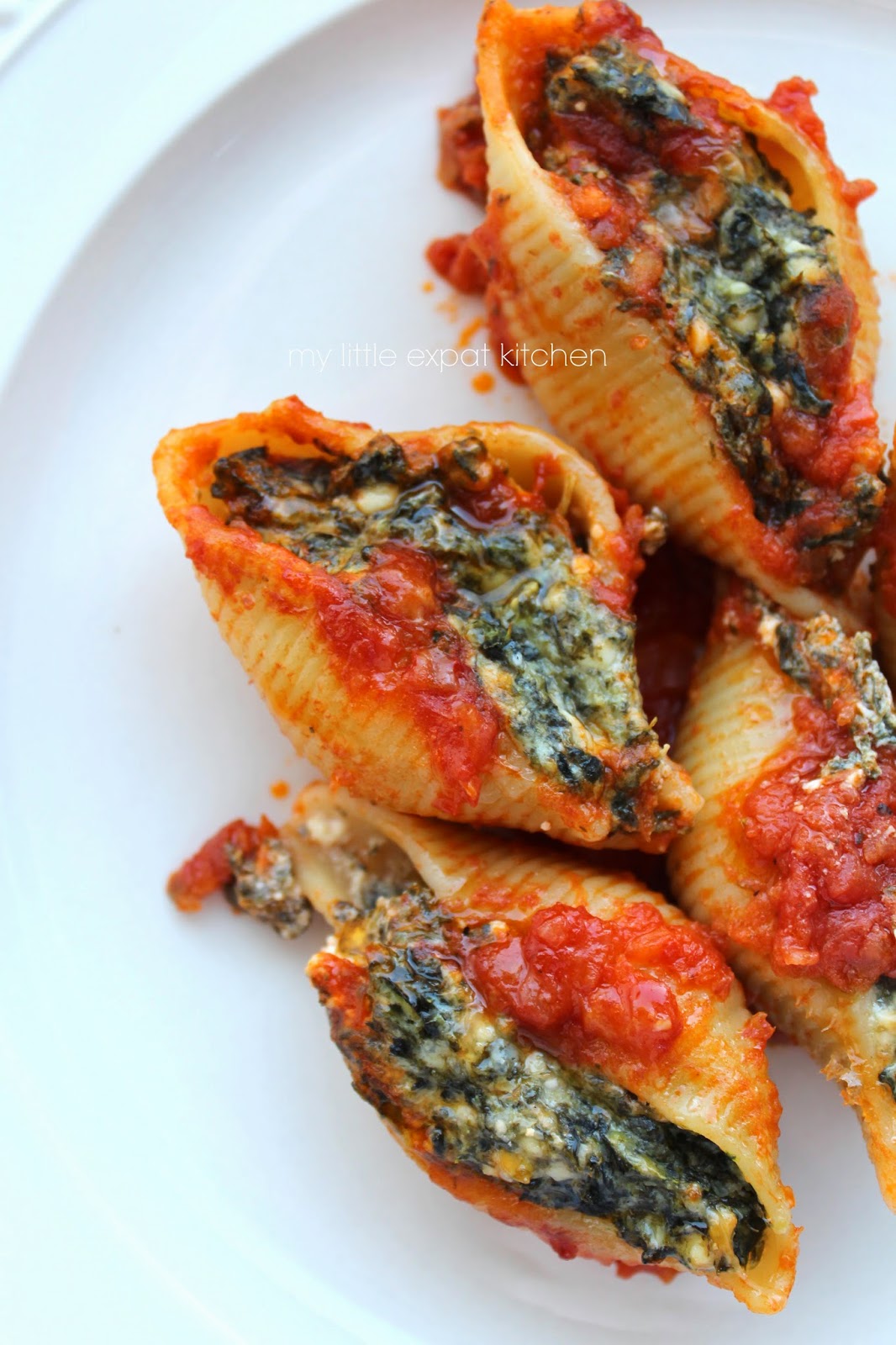
A dish of stuffed jumbo pasta shells with fresh spinach, feta, ricotta and parmesan, baked in the oven with a tomato sauce.


It is a stunning dish both visually and taste-wise. The combination of colors and flavors is irresistible in its simplicity and frankly, it’s a classic; slightly acidic, full-of-iron flavor of the spinach, saltiness of the cheeses each with its own unique character, sweetness of the vibrant tomato sauce.


A perfect dish for a dinner with friends, especially for those who are vegetarians (you know who I'm talking about), or for a Sunday lunch with family.


Pasta shells with spinach, feta and ricotta

If you can get your hands on the fresh Greek cheese called anthotyro, do use it instead of the ricotta.

Most of the times, I use fresh spinach to make the filling but frozen and thawed (and squeezed off of its juices) spinach works quite well too.

You can use the classic pasta shells (conchglioni) that I used, or lumaconi.


Yield: about 32 shells / enough for 6 people

Ingredients
250 g jumbo pasta shells (about 35 shells because some of them might break)

for the filling
500 g fresh, trimmed spinach leaves (you should have about 230 g after cooking and squeezing out the juices)
250 g fresh ricotta, crumbled
200 g feta, grated
50 g parmesan, grated
1 medium-sized egg
Freshly ground black pepper

for the sauce
3 Tbsp olive oil
2 onions, grated
2 garlic cloves, finely chopped
400 g canned chopped tomatoes
1 heaped tsp tomato paste
Salt
Freshly ground black pepper
250 ml hot water

20 g parmesan for grating over the top of the shells before baking

Special equipment: colander, box grater, rasp grater, large baking dish (I use a 36cm x 25cm ceramic baking dish), aluminum foil


Preparation
Fill a large pan with water by ¾ and boil over high heat.
Rinse well the spinach leaves, drain them in a colander and add them to the boiling water. Boil the spinach for 4 minutes without putting the lid on the pan. Drain in the colander and leave to cool. Before using in the filling, squeeze well the spinach between your hands so that you get rid of the liquid. Then chop with a knife.

for the sauce
In a medium-sized saucepan, add the olive oil and heat over medium heat. Add the onions and garlic and sauté until they soften and become translucent. Add the chopped tomatoes, tomato paste, salt and pepper and stir well. Add the water and stir again. Let it come to the boil and turn heat down to low. Put on the lid and let the sauce simmer for 30 minutes.

for the pasta
In the meantime, boil the pasta. Bring a large pot of salted water to the boil over high heat and add the pasta shells. Cook 2 minutes less than indicated on the package. They need to be al dente (firm but not hard) otherwise they will break or collapse and you won’t be able to fill them. Drain the pasta in a colander, discarding the water, and immediately rinse them under cold running water until completely cool. This will stop the cooking process and will also make them not stick to one another. While you are rinsing them, gently separate those that tend to stick together or inside one another.

for the filling
Add the squeezed and chopped spinach in a medium-sized bowl, along with the cheeses, the egg and a little black pepper. Mix well with a spoon. Don’t be tempted to add salt to the filling. The cheeses are already salty enough.


Preheat your oven to 180 degrees Celsius.

Take your baking dish and add half of the tomato sauce, spreading it evenly around the bottom of the dish with the back of a spoon.
Fill each pasta shell with about 1½ tsp of the filling and immediately place the shells upright in the baking dish. Continue making the rest and adding them to the dish until you have no more filling left.
Pour the rest of the tomato sauce between and over the stuffed pasta shells. Grate the parmesan (20 g) on top of the shells.


Cover the dish loosely with aluminum foil and place on the lower rack of the preheated oven. Bake for 30 minutes and then remove the foil, transfer dish to the middle rack and bake for a further 15-20 minutes.

Remove from the oven and allow to cool a bit before serving.

They are best eaten the day you bake them but the next day they are also good. Keep in mind though that they will be somewhat dry.