Tampilkan postingan dengan label poultry. Tampilkan semua postingan

Selasa, 05 Mei 2015

Chicken and beetroot salad with orange, fennel and feta

From the layer cake of my last post to a salad. Huge difference, right? But there needs to be some kind a balance to what we eat. So, salad it is, and my favorite type of salad at that. One that is a full meal, with chicken, to fill you up and make you happy.


This is the type of meal I like on these early spring days, when it’s getting warm and I don’t want heavy dishes but rather light and bright ones. Salads are my go-to dishes during this time of year.


Colorful beetroots—golden, white, chioggia—that make the salad even more appetizing, greens, because I like my salads with a bit of green, feta, because I’m a feta fiend, and chicken, my favorite kind of meat.


With fresh, liquoricy fennel and a citrus dressing with orange zest, lemon juice, honey and olive oil to tie everything together. With crunchy walnuts, because when we eat something it’s not only the flavor that counts but also the texture, and some juicy orange segments, because, yes, we may all have fallen head first into the seasonal strawberries, but there are some luscious and tasty oranges left for us to savor too. So grab them while you still can.


The play of flavors is quite interesting in this salad—refreshing, sweet, sharp, earthy—making it a salad ideal for my palate. I hope it suits yours too.


Chicken and beetroot salad with orange, fennel and feta

Feel free to substitute the types of beetroot I used for regular red beetroot. Just be aware of the fact that red beets stain any other ingredient that has the audacity to share the same plate with them, so if your salad takes on a pink hue, don’t say that I didn’t warn you. Adding it at the last minute and tossing the salad ever so slightly, will save the situation though.

Use a mandoline, if you have it, to achieve those paper-thin slices. A mandoline would also be ideal to cut very thin slices of the onion and fennel.

If you don’t like feta—you don’t like feta????—use any other creamy white cheese you like that is sharp, not sweet.

I used two boneless and skinless chicken breasts that I seasoned with salt, pepper and cayenne, and cooked them in a frying pan with a little olive oil. You can use, however, any leftover chicken you may have, from roast chicken to grilled chicken, and it can be any part of the chicken as long as you cut it into bite-sized pieces.

This salad can be eaten either for lunch or dinner as it is quite filling yet light.


Yield: 2 main-course or 4 salad servings

Ingredients
2 large oranges
350 g raw beetroots (golden, white, chioggia), peeled and very thinly sliced
2 Tbsp lemon juice, freshly squeezed
2 Tbsp orange juice
Salt
3 Tbsp extra virgin olive oil
1 tsp white balsamic vinegar
1 tsp runny honey
Zest of 1 orange, finely grated
Freshly ground white pepper
150 g mixed baby leaves
½ large fennel bulb, trimmed and very thinly sliced, fronds reserved
1 medium red onion, peeled and thinly sliced
300 g cooked chicken, chopped into bite sized pieces
80-90 g feta, cubed
50 g walnuts, roughly chopped

Special equipment: mandoline (optional yet preferable), rasp grater


Preparation
Grate the zest of one of the oranges and place it in a small bowl.

The way to cut the 2 oranges is by using a sharp knife. First, cut off the peel, then the white pith all around the fruit, exposing the flesh, and finally, cut free the flesh of the fruit from the membranes that are in between the wedges. Squeeze the juice out of the membranes and into a large bowl. They should be about 2 Tbsp. Add the thinly sliced beetroot to the bowl along with 1 Tbsp lemon juice and ¼ tsp salt and mix well. Let stand for 15 minutes so the beetroot softens a bit.

Make the dressing. In the small bowl that you added the grated orange zest, add the olive oil, white balsamic vinegar, honey, the remaining 1 Tbsp lemon juice, a good pinch of salt and some white pepper, and using a wire whisk, blend well.

In a large bowl, mix gently with your hands the baby green leaves, fennel, red onion and the chicken. Add the oranges and the beetroot with its juices and mix gently with your hands. Scatter the feta and walnuts on top and finally pour over the dressing. Sprinkle with the reserved fennel fronds and again, using your hands, toss gently to combine all the ingredients.

Serve immediately with some fresh bread and a glass of dry white wine.


Senin, 24 Februari 2014

Duck legs with green olives (and exciting news)

This winter has been extremely mild here in The Hague and in the Netherlands in general. We haven’t seen a single flake of snow, the rain hasn’t been falling as heavily as in previous years, and it hasn’t been very cold at all, at least for Dutch standards.


I have two duvets, one light and one heavy, and this is the first time in more than six years that I have been living here, that I have not switched to the heavy one for the winter. It is unbelievable and I’m saying this in a good way.


I love this weather. We’ve had a lot of sunny days and not those gloomy never-ending ones, and there have been some days that I have actually felt like I was back in Greece.


Spring has not yet arrived though, it is still winter, and throughout the season, I have been making all types of stews and slow-cooked, meat and poultry dishes. This one I made the other day when I was looking to cook something different than the traditional Greek meat stews and braises I usually make.


S and I love duck and even though we mostly opt for the quick-cooking duck breast, this time we chose duck legs. I thought about making duck confit at first, but then the idea of oven-braising the legs popped into my mind.


This is a duck-leg braise with Mediterranean flavors, one cooked very much the French/Italian way, with Greek green olives, bacon, celery, onion and carrot, ground aniseed and tomatoes. The duck legs are first baked in the oven over high heat in order for the fat to render and crisp up and then they are braised in the oven over a low heat along with all the vegetables, olives and bacon.


This dish is exceptional; highly flavorful and aromatic, deeply satisfying and quite unique. Briny olives with succulent, honeyed sweet duck meat, all dark and juicy, with crispy rendered skin; salty bacon adding extra flavor and aniseeds giving a spicy aromatic quality; tender vegetables; earthy sauce perfect for dipping, not too fatty but not for the faint-hearted either; acidity and freshness from the grated orange zest and chopped parsley, balancing the sweetness, brininess and earthiness of the dish. Paired with a creamy homemade potato purée it is perfection on a plate.


Now on other super exciting news, I am a finalist on theKitchn’s The Homies Awards, for the category “Best Blog from Abroad”. Yay! You can’t imagine how thrilled I was when I found out about it yesterday. I’m so honored to be among food bloggers whose work I admire immensely.
Of course I am the underdog and I know I’m not going to win, but it's always nice to be hopeful and it would make me so happy if you voted for me. Please click on this link to do so (until February 27th, 6:00 a.m. Central European Time). You have to be registered with theKicthn to vote, so if you are not yet registered click here first (you can sign in with facebook or twitter too).
I appreciate your support!!


Oven-Braised Duck Legs with Green Olives
Adapted from Bill Granger

I used large duck legs (from male ducks) but you can also use smaller ones (from female ducks). Get a couple more though if you want to feed six people.

I opted to serve the duck legs with potato purée but you can also serve them with fried potatoes.


Yield: 4-6 main-course servings

Ingredients
4 large duck legs with thighs attached (350 g each)
1 Tbsp olive oil
100 g bacon slices, chopped
1 large onion, finely chopped
2 celery sticks, sliced
1 carrot, diced
2 garlic cloves, peeled and sliced thinly
¼ tsp heaped aniseed powder
1 dried bay leaf
150 ml dry white wine
400 g canned chopped tomatoes
250 ml chicken stock
100 g pitted green olives (about 30)
Salt
Freshly ground black pepper

2 Tbsp fresh flat-leaf parsley leaves, chopped, for serving
2 tsp orange zest, finely grated, for serving

Special equipment: Dutch oven or other large pan with lid that can go from stovetop to the oven, rasp grater


Preparation
Take the duck legs out of the refrigerator at least half an hour before you cook them so they come to room temperature. Rinse them under cold running water and pat them dry with paper towels.

Preheat your oven to 220 degrees Celsius.

Place duck legs on a large baking tray and season well with salt and pepper on all sides. Bake on the middle rack of the oven for about 30 minutes, until the legs are golden brown and a lot of the fat has rendered.
Remove the baking tray from the oven and lower temperature to 160 degrees Celsius.


In a Dutch oven (or other large pan with lid that can go from stovetop to the oven), add the olive oil and heat over medium heat. Once it starts to shimmer, add the chopped bacon and cook, stirring occasionally for about 5 minutes or until it has crisped up.


Add the chopped onion, celery and carrot and cook, stirring occasionally, for about 6 minutes, until the vegetables have softened. Add the garlic and cook for 2-3 minutes, stirring often.
Pour the wine into the pan and simmer for 3 minutes until it has reduced by half, then add the ground aniseed and bay leaf and stir well.
Add the canned chopped tomatoes, the chicken stock and the olives and stir well.


Add the browned duck legs to the pan over the vegetables, in one layer, fatty side up (just like in the photos). They need not be immersed in the liquid in order for the skin to stay crispy, besides there’s not enough liquid for this to happen anyway.


Note: Empty the baking tray from the rendered fat and pour it into a bowl. Once it cools, you can keep it in the fridge, covered tightly and use it to cook potatoes or eggs.

Bring to the boil over medium-high heat and immediately put the lid on the pan. Transfer pan to the oven and cook for 1½-1¾ hours, or until the meat is very tender.

Remove from the oven and serve topped with grated orange zest and chopped parsley. Serve with potato purée or fried potatoes.

The next day, the duck legs will be as delicious, if not more.


Senin, 30 Desember 2013

Last but not least

And while some of you are probably still looking for recipes for New Year’s Day ham or small desserts and canapés for your New Year’s Eve party, I already know exactly what I’m making.


At last, and perhaps for the first time ever, I have come up and finalized a menu, unlike previous years when I always waited for the last minute to make my mind up about what to cook.


On New Year’s Eve, I’m making braised quails with chestnuts and fresh sage (for those of you who don’t know me well, I should tell you chestnuts are my favorite nut, even when it’s not the holiday season), and on New Year’s day, I’m making oven roasted pork shoulder with juniper berries and wild mushrooms.


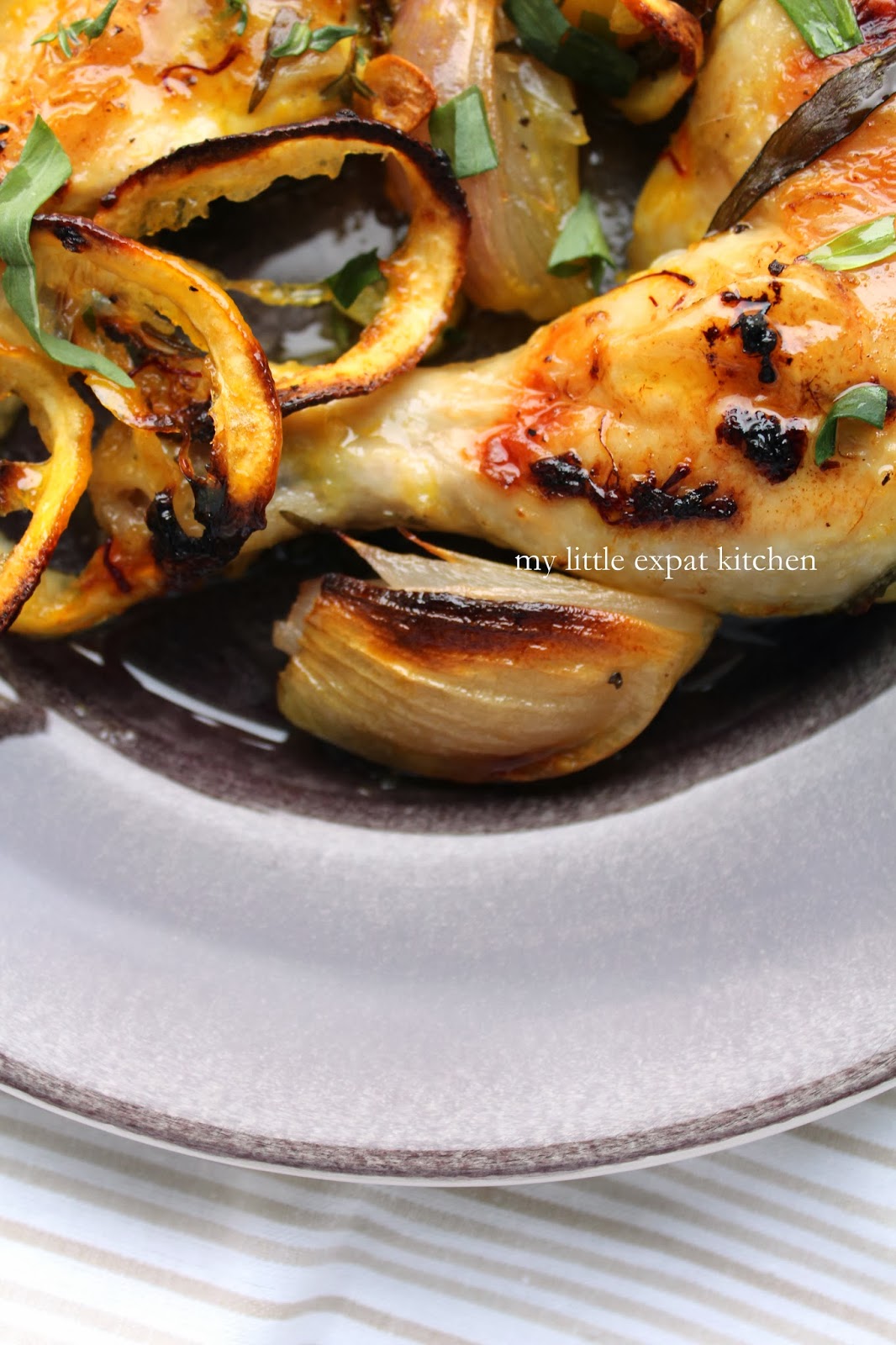
Unfortunately I don’t have photographs or recipes to share as I haven’t cooked these dishes yet, but what I can’t wait to share with you is this chicken dish with saffron, shallots, lemon and Jerusalem artichokes (that are neither an artichoke nor from Jerusalem but are a sweet- and earthy-tasting tuber).


I have made this two-three times before, with the last one being for a festive dinner, and it was greeted with enthusiasm. I personally find it extremely tasty with a combination of flavors that is quite interesting.


You start by boiling the Jerusalem artichokes in water until tender, then add all the ingredients in a large bowl, give them a good toss and you leave the chicken to marinate overnight or at least for a few hours.


The following day, you empty everything into a large baking pan and place it in the oven to cook. Your house fills with intoxicating aromas and after a little less than an hour, out comes a golden-hued dish full of delicious flavors.


The slightly metallic notes of saffron, the sweet shallots without that audacious oniony bite, the caramelized sharpness and sourness of the lemon, the liquorice-y nuances of the tarragon, the sweet, buttery Jerusalem artichokes soaking up all the lovely juices from the sumptuous, well-cooked chicken, they all conspire to create a dish that is absolutely stunning.


I wish you all a happy, healthy New Year filled with love, patience, perseverance and lots of laughter! Have a great time wherever you are and whatever you do!


Marinated Roast Chicken with Saffron, Shallots, Lemon and Jerusalem Artichokes
Slightly adapted from Jerusalem by Yotam Ottolenghi and Sami Tamimi

Jerusalem artichokes also go by the name sunchokes. For those of you reading from Holland, they are called aardperen (singular: aardpeer).
If you can’t find them you can substitute with small round potatoes.

We usually have this with a green leaf salad but you can also serve it with a simple steamed/boiled rice, preferably an aromatic basmati.

I used a mandoline to thinly slice the lemon. Use it if you have one, otherwise a very sharp knife will do an equally good job.


Yield: 2-4 main-course servings

Ingredients
600 g Jerusalem artichokes (400-500 g peeled), peeled and cut into wedges about 1.5 cm thick
1 Tbsp lemon juice
1 chicken, about 1,200 g, cut into 6-8 pieces*
7-8 banana shallots, peeled and halved lengthwise
8 large garlic cloves, peeled and sliced
1 small lemon, sliced very thinly lengthwise
1 good pinch of saffron threads
60-70 ml (4-5 Tbsp) olive oil
130 ml cold water
3-4 fresh thyme sprigs, leaves picked
3-4 fresh tarragon sprigs, leaves picked, plus extra for garnishing
Salt
Freshly ground black pepper

*I always cut the chicken into six pieces; legs, wings and breasts. You can also cut it into eight pieces, separating the legs into thighs and drumsticks, but I prefer not to because they remain juicier.

Special equipment: colander, large barking tray, plastic wrap or plastic bag appropriate for storing food


Preparation
In a medium-sized pan, add the peeled and cut Jerusalem artichokes along with the lemon juice and cover them with water. Bring to the boil over medium-high heat and then reduce heat to low and simmer for about 10 minutes or until the Jerusalem artichokes are tender but not soft because they will continue cooking with the chicken in the oven. Drain in a colander and leave to cool completely.

In a large bowl, add the Jerusalem artichokes, chicken pieces, shallots, garlic and lemon slices, saffron, olive oil, water, thyme and tarragon leaves, salt and pepper. Mix well and cover the bowl with plastic wrap or alternatively, place all the ingredients in a plastic bag suitable for storing food and seal it. Leave to marinate in the refrigerator overnight or for at least 2 hours.

Take it out of the fridge 20 minutes before you put it in the oven, to allow it to come to room temperature.

Preheat your oven to 200 degrees Celsius / 390 Fahrenheit.
Place the marinated chicken, skin-side up, in a roasting tray large enough to fit all the pieces in one layer, and arrange the rest of the ingredients between the chicken pieces. Drizzle the juices on top.


Place the pan on the middle rack of the oven and roast the chicken for about 50 minutes, until it takes on a golden brown color and the skin becomes crispy and caramelized. Also, if you insert a knife or skewer in the thickest part of the chicken pieces, the juices should run clear and not be reddish in color. Don't cook for longer because the chicken will dry out and become tough.

Serve in dishes, sprinkled with some chopped fresh tarragon leaves.


Selasa, 18 Desember 2012

Fat duck

I don't think poultry is properly represented on this blog of mine even though we eat our fair share of it.


We have chicken very often, once, sometimes twice a week, and when I want to be more adventurous and a little bit naughty, I cook duck, goose or quail, particularly for special occasions.


Duck is not a simple little bird, it's not like chicken. It is gamey and delicious and pretty fatty, with its beautiful thick layer of skin that renders and becomes the stuff culinary dreams are made of. Roast potatoes and fried eggs are completely transformed when cooked in duck fat. Try it.


During the holidays, I love to prepare duck confit which is a French dish of duck legs that are first salted and refrigerated for up to thirty-six hours and then slow-cooked, poached really, in their own fat. The result is superb but I don't always have time for such complicated dishes.


The simplest and quickest way for me to enjoy duck is by pan-frying the breast. I usually pair it with roasted vegetables or baked potatoes (in duck fat of course) but recently I discovered a wonderful accompaniment for duck breast. A warm salad of Beluga lentils with cranberries and spinach. Quite festive too.


The pairing is marvelous. The duck breast is crispy crackly on the outside and tender and moist on the inside but it needs something to cut through all that richness and that's where the salad comes in. The earthiness of the lentils and the tangy acidity of the cranberries complement perfectly the sweetness and fattiness of the duck, while the spinach freshens up the whole dish.


It is a complete and utter delight, ideal for a festive dinner or even for an alternative Christmas lunch. Unconventional is the way to go sometimes.


Pan-Fried Duck Breast with a Warm Salad of Beluga Lentils, Spinach and Cranberries
Adapted from Food & Travel

Beluga lentils are small black lentils. They're called beluga because when raw and wet, they glisten and strongly resemble caviar. They are very similar in texture to the French green Puy lentils as they keep their shape when cooked. If you can't find them, substitute with Puy lentils.

Pair the dish with a red Côtes du Rhône.


Yield: 4 main-course servings

Ingredients

for the salad
200 g fresh cranberries
1 Tbsp caster sugar
100 g baby spinach leaves
150 g Beluga lentils
2 Tbsp olive oil
3 shallots, finely chopped
3 garlic cloves, mashed
Salt
Freshly ground black pepper

for the duck
4 duck breast fillets with skin (about 200g each)
Salt
Freshly ground black pepper

Sprouts and garden cress for garnishing

Special equipment: colander, large skillet or sauté pan


Preparation

for the salad
Rinse the cranberries under cold running water and place them in a small bowl. Sprinkle them with the sugar and mix well with a spoon.
Rinse the spinach under cold running water and drain well.

Rinse the lentils well under cold running water.
In a medium-sized saucepan, add the olive oil and heat over medium heat. When it starts to shimmer, add the shallots and garlic and sauté for about 5 minutes, stirring regularly, until they soften but don't brown. Add the lentils to the pan and sauté them lightly for 1 minute stirring continuously. Then add enough warm water to just cover them. Don't add a lot of water otherwise the salad will be watery. Bring the lentils to the boil and then turn heat down to low and simmer for 13-15 minutes, with the lid half-on, until almost cooked.
Note: if you find that there's too much water, remove the extra liquid with a spoon from the pan.


Add the cranberries to the lentils and cook, stirring often, over medium heat for 5-10 minutes, until the cranberries start to burst. Be careful though because you don't want the berries to turn mushy.
Then add the spinach leaves, season with salt and freshly ground black pepper and mix well with a spoon. The spinach will wilt from the heat of the lentils and cranberries.
Keep the salad warm and prepare the duck.


for the duck
Take the duck breasts out of the refrigerator at least half an hour before you cook them so they come to room temperature. Rinse them under cold running water and pat them dry with paper towels.
Using a sharp knife, score the skin all over in a criss-cross pattern, being careful not to cut through the meat but just the skin. The scoring will help to render the fat and make the skin crispy. If there is any skin hanging over the edge of the breast, remove it with your knife.
Season the breast on both sides with salt and freshly ground black pepper and make sure to rub the seasoning well onto the skin.


Heat a large, heavy-bottomed skillet (I use a cast-iron skillet) or sauté pan over medium heat. There's no need to add any oil because the duck will render a lot of fat. Add the duck breasts, skin-side down and immediately turn heat down to medium-low. Cook for about 7 minutes, until the fat is rendered and the skin is crispy and brown. Empty the pan from the rendered fat and pour it into a bowl. Once it cools, you can keep it in the fridge, covered tightly and use it to cook potatoes or eggs.
Turn the duck breasts over and cook for 4-7 minutes, depending on how you prefer to eat your duck. If you like it medium-rare then cook it for 4 minutes; if you like it well-done cook for 7 minutes.
If your duck breasts are smaller or bigger than the ones indicated here then you'll need to adjust the cooking times. Also, the layer of fat of your duck breasts might be thinner or fatter so adjust the time of rendering accordingly, otherwise your duck will be too fatty.

Transfer the duck breasts to a clean cutting board and cover lightly with a piece of aluminum foil so that they don't get cold. Let the duck breasts rest for 7-9 minutes. Resting the meat is very important because it relaxes and the juices spread equally throughout it. If you cut the meat right after you've taken it off the heat, all the juices will run out instead of staying in and keeping the meat moist.

With a sharp knife, cut the breasts at an angle into thick-ish slices and place on individual plates.
Add the lentil salad next to each duck breast and garnish with the sprouts, the garden cress and some fresh small baby spinach leaves and serve immediately. Enjoy!