Tampilkan postingan dengan label Easter. Tampilkan semua postingan

Rabu, 23 April 2014

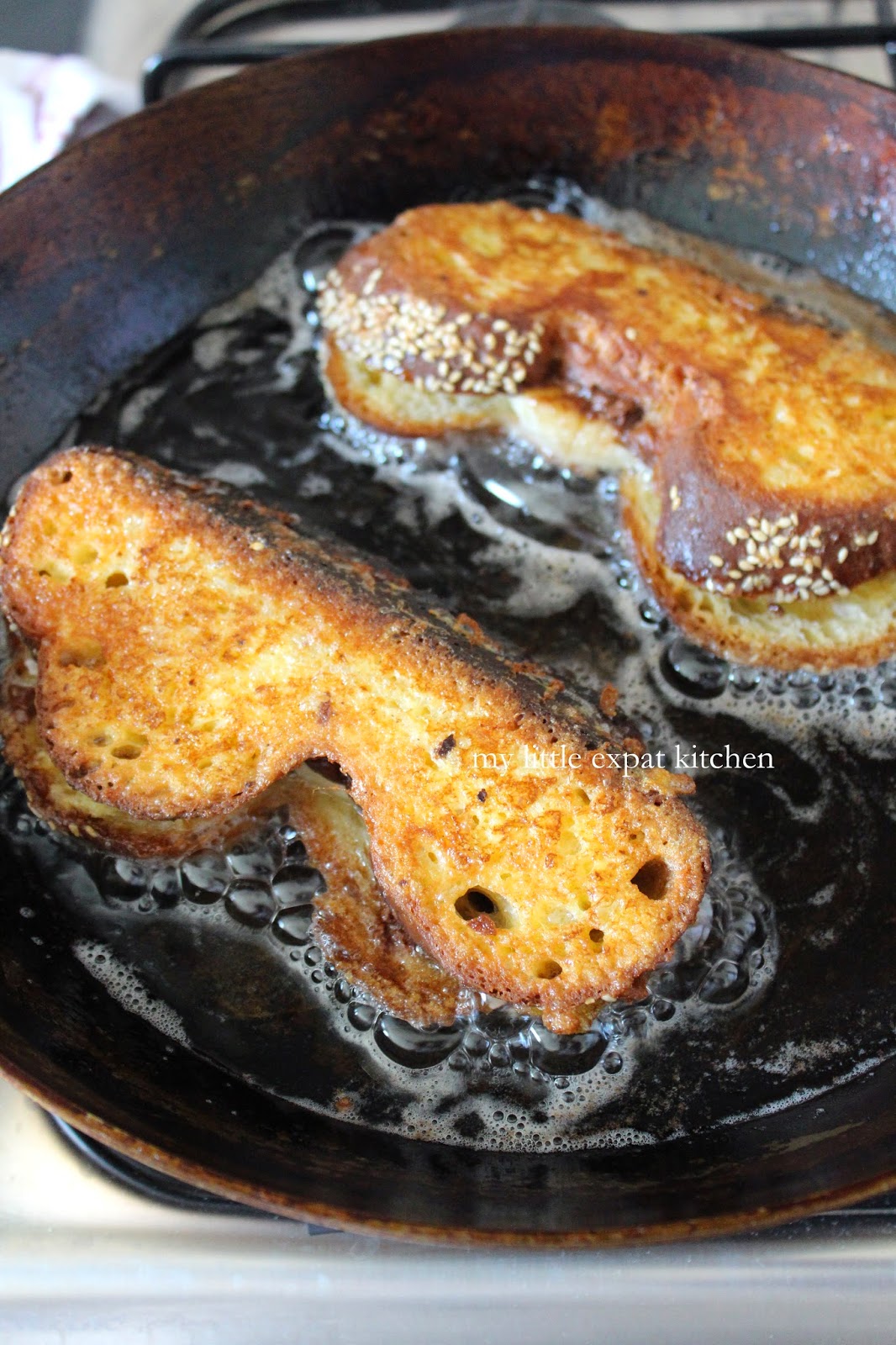
Tsoureki french toast x 2


Hello everyone and Christos Anesti to my fellow Greeks!
I hope you all had a good Easter with lots of good food and company.


My Easter was filled with lamb, roast potatoes, eggs and salads of all kinds, with wine and tsoureki and koulourakia and the expected food coma that comes afterwards, when all you can do is lie on the couch, motionless.


The next day though, hunger strikes again, as it always does, and the leftover tsoureki (Greek Easter sweet bread) gets a second life. The act of making French toast ensues and that’s exactly what happened on Easter Monday.


My tsoureki was not that sweet, I added less sugar this year, so the addition of ripe bananas and nutella was the perfect thing to do. Besides, who can possibly resist the image of Nutella oozing out of two pieces of fried bread?


Needless to say, the combination of hazelnut, chocolate and banana is out of this world, but the mahlepi and mastiha in the tsoureki elevated this filled French toast to a whole new level of deliciousness. To make things even better (or worse, depending on who you’re talking to), I also added some Frangelico, a hazelnut liqueur, in the eggs and milk mixture and it really brought out the nuttiness in the nutella, giving the French toast a lovely flavor.


Nevertheless, my all-time favorite way to eat French toast, or avgofetes (αβγοφέτες) as we call them in Greece, is simply by drizzling them with Greek honey, preferably thyme honey and dusting them generously with ground cinnamon. That, to me, is the quintessence of simplicity.
So take your pick and enjoy your left-over tsoureki bread or any other type of bread you have around the house.


Avgofetes Tsourekiou me Meli kai Kanela (Tsoureki French Toast with Greek Thyme Honey and Cinnamon)

My Politiko tsoureki is ideal for French toast because it retains its structure when it gets stale and has a well-browned crust and robust crumb.
You can substitute of course with other types of sweet bread like brioche or challah, or any other type of non-sweet bread. The staler the bread, the better it is as it will soak up more of the egg-milk mixture.


Yield: 4 servings

Ingredients
2 large eggs
50 ml fresh milk, full-fat
8 thick tsoureki bread slices (or any other bread you have on hand, sweet or not)
Sunflower oil, for frying
Greek thyme honey or other runny honey of your choice, for drizzling
Ground cinnamon, for sprinkling


Preparation
In a deep and wide plate, add the eggs and milk and beat with a fork.

In a large frying pan, add enough sunflower oil to cover the base by about 1 cm and heat over medium heat.

Dip the bread slices in the egg-milk mixture, soaking them well on both sides and then add them one by one to the hot oil. Add as many slices as the pan fits. Fry them 2-3 minutes on each side or until cooked through and browned, and transfer them to a plate covered with paper towels to absorb the extra oil. Continue frying the rest.

Place the bread slices on a plate, drizzle with as much honey as you want and dust with cinnamon.
Enjoy while still hot.


Tsoureki French Toast Filled with Nutella and Banana

If you use tsoureki or any other sweet bread for this, choose a banana that is not too ripe, whereas if you use regular bread, choose a very ripe banana for extra sweetness.


Yield: 2 servings

Ingredients
4 thick tsoureki bread slices (or any other bread you have on hand, sweet or not)
2 large eggs
50 ml fresh milk, full-fat
1 Tbsp Frangelico or other hazelnut liqueur (optional)
Sunflower oil, for frying
Nutella or other hazelnut-chocolate spread
1 large ripe banana, sliced on the diagonal


Preparation
In a deep and wide plate, add the eggs and milk and beat with a fork. Add the Frangelico (if using) and whisk to incorporate.

In a large frying pan, add enough sunflower oil to cover the base by about 1 cm and heat over medium heat.


Using the 4 slices of bread, make two sandwiches by spreading as much or as little Nutella as you want on one slice of bread, top with banana slices in one layer and then top with the second slice of bread.

Dip the sandwiches in the egg-milk mixture, soaking the bread slices well and then add them one by one to the hot oil. Fry for 2-3 minutes on each side or until cooked through and browned, and transfer them to a plate covered with paper towels to absorb the extra oil.

Serve immediately while the nutella oozes out of the sandwich.


See also this Tsoureki bread and butter pudding with strawberries, vanilla and currants.


Kamis, 17 April 2014

Paschalina Koulourakia - Greek Easter cookies

Last night, I started preparing the traditional tsourekia (Greek Easter yeasted sweet breads). I kneaded the dough until soft, smooth and shiny and placed it in the fridge to rest and proof overnight.


Today, as I took it out of the fridge, my nostrils were filled with the aroma of mahlepi and mastiha and I couldn’t wait to bake my breads. I braided the long strips of dough and after an hour or so, my beautiful tsourekia were ready. It was so hard to resist eating them right there on the spot.


Yesterday, though, I made something equally irresistible and delicious; paschalina koulourakia (Πασχαλινά κουλουράκια), Greek Easter cookies, and this year’s batch was a revelation.


I make traditional Greek Easter cookies every year but I was never quite satisfied with the result. Sometimes they were too sweet, other times they puffed up too much or were too hard. This time however, after studying my notes from previous years and making the appropriate adjustments to my recipe, I came up with the ideal, for me, cookies.


They are somewhat longer than the classic cookies of this type, crispy but not hard or crunchy, they have the heady aroma of butter, vanilla and orange, and the sesame seeds on top give a pleasant nuttiness and added texture. Without being too sweet or heavy, they are indeed the best Greek Easter cookies I have ever made.


Hope you give them a try!

Happy Easter to all those who celebrate!


Paschalina Koulourakia (Greek Easter Cookies)

These are the type of Greek Easter cookies served on Easter Sunday since they contain eggs and butter (not Lenten). Τhey are perfect to dunk into your morning or afternoon coffee without disintegrating (an oh-so-important characteristic of a good Greek cookie).


Yield: 35 cookies

Ingredients
200 g unsalted butter, at room temperature, cut into small pieces
200 g caster sugar
1 tsp pure vanilla extract
Zest of 1 orange, grated
2 medium-sized eggs, plus 1 beaten egg for glazing the cookies
400 g all-purpose flour, plus extra for dusting
2 tsp baking powder
Sesame seeds, for sprinkling

Special equipment: stand mixer or hand-held electric mixer, plastic wrap, large baking sheet, baking paper, pastry brush


Preparation
In the bowl of your stand mixer (or in a large bowl) add the butter and sugar and using the paddle attachment (or with your hand-held mixer) beat on medium-high speed until you have a creamy and light mixture. Add the vanilla and grate the orange straight into the bowl so that all the oils from the orange zest fly into the mixture and beat for a few seconds to incorporate. Add the eggs one at a time, beating well after each addition to incorporate them fully. Then add the flour and baking powder and mix over low speed until just combined.


Flour generously a clean work surface and empty the dough on top. Flour the top of the dough and knead with your hands for 2-3 minutes, sprinkling with more flour if it sticks to your hands (I had to sprinkle flour a couple of times to achieve the desired consistency), until the dough is soft and pliable but is not sticking to your hands. It may seem that it needs more flour but it doesn’t. You don’t want it to become stiff or too firm otherwise your cookies will be tough rather than crispy.


Shape it roughly into a ball and cover it with plastic wrap. Put it in the fridge for 20 minutes to rest.

Preheat your oven to 180°C.
Line your baking sheet with baking paper.

Remove the dough from the fridge, unwrap it and using a tablespoon measure, scoop out the dough, roll into a small ball (walnut-sized), and then roll it out with your fingers into a thin rope 25-26 cm long. Fold it in half and then twist the ends over each other three times to create the final shape of the cookie.

Note: You don’t need to flour your work surface because a) the dough shouldn’t be sticky at all and b) you need friction in order to shape the balls into ropes.


Place each cookie on the prepared baking sheet and continue with the next. Space them a bit apart as they will spread a little during baking. Using a pastry bush, glaze each one with the beaten egg and sprinkle with a few sesame seeds.

Place the baking sheet on the middle rack of the preheated oven and bake the koulourakia for 15-17 minutes, until set and golden, being careful not to burn them. The edges tend to burn easily so you may want to turn the baking sheet around halfway through the baking time.


Take them out of the oven and transfer them onto a wire rack to cool.
Continue baking the rest of the cookies.

Once cooled, you can keep them in a cookie tin for 1-2 weeks.


Sabtu, 12 April 2014

Greek fried calf’s liver with onion and parsley

Calf’s liver two days before Holy Week? Yes, because if you have low iron levels and your doctor tells you that either you start eating more red meat or you start taking iron pills, well, I chose meat, calf’s liver to be exact as it’s been a favorite treat of mine since childhood. Now, unfortunately, I neglect to buy it. How come this never happens with chocolate?


So I finally got some liver the other day from the butcher and of course I ended up eating it alone as S is notoriously anti-liver of any kind. I didn’t complain. Don’t go thinking however that I ate all the liver you see in these photos, no, these were taken back in October when I was home in Greece and the pictured liver was cooked lovingly by my grandmother.


This is my favorite way of eating calf’s liver; in the style of Greek cooking I was brought up with, the “Politiki cuisine” (read about it here). You cut the liver into cubes, flour and shallow fry it in olive oil. You serve it with a good amount of finely sliced red onion mixed with chopped flat-leaf parsley and you’re set!


The liver needs to be pinkish inside otherwise you end up with a chewy mess and you don’t want that. It should be eaten freshly fried accompanied by a small glass of ouzo, some hand-cut fried potatoes and a horiatiki (Greek) salad.


I don’t know if any of you are fasting or not, and trust me I don’t want to be the one who tempts you to break your fast, so I will suggest you have this dish on Easter day. It makes the perfect, pre lamb-feasting meze.


Sikotaki Politiko (Greek Fried Calf’s Liver with Onion and Parsley)

This for me is the best way to cook calf’s liver, not to mention one of the simplest.
There are no specific measurements for this recipe as they are easily adaptable to the amount of liver you want to serve.


Ingredients
Calf’s liver slices
All-purpose flour
Olive oil, for frying
Salt
Freshly ground black pepper
Lemon, for squeezing juice on top

Red onion, thin half-moon slices
Fresh flat-leaf parsley leaves, chopped


Preparation
Remove the outer membrane from the liver slices as well as any nerves. Cut the liver into bite-sized pieces.
In a large plate or round pan, add flour and add the liver pieces. Toss to coat them well with the flour.


In the meantime, in a large frying pan, add enough olive oil to cover the bottom of the pan and heat over medium-high heat. Once the oil heats well (it needs to be very hot but not smoking), add the liver pieces in batches, shaking off the extra flour and being careful not to overcrowd the pan. Fry 1 minute on each side but not more, otherwise it will be chewy.


Using a slotted spoon, remove the liver pieces from the pan and onto a platter, sprinkle with salt and pepper (salt is not added before cooking as it makes the liver tough), and squeeze some lemon juice on top.

In a small plate, mix the onions and parsley.
Serve liver immediately, with a good amount of onion-parsley on top or on the side.


Senin, 13 Mei 2013

Greek eats


Hello, friends. And Christos Anesti to all my fellow Greeks.


Orthodox Easter came and went and all I can say is that I ate more than I could handle, but I enjoyed it immensely. During Lent it was all about shellfish and occasionally fish, but Easter was all about the meat.
Lamb,


kokoretsi (lamb's liver and lungs wrapped with lamb's intestines),


and kontosouvli (pork neck pieces on a spit).


Since we unanimously decided that we didn't have enough meat (!) on Easter day, it was all about veal steaks and pork sausages the day after.


I could have definitely used a break, but no, I had to have more. I’d missed my beloved pastourma (seasoned, air-cured beef) and soutzouki (spicy, fresh sausage made with beef meat).


My mom made pastourmadopitakia, small pies with pastourma, tomato and Greek sheep's milk Graviera cheese from Metsovo. They were so tasty I ate more than I should.


A lot of eggs were consumed. Not by me, but by everyone else.


If you know any Greeks, then you must know that we are all crazy about our cheeses. I, in particular, am nuts about Feta, and Anthotyro (soft, sheep's and/or goat's milk cheese) which I haven’t eaten in a long time.


Pites, Greek flatbreads, are an excellent accompaniment to meats of any kind.


For salad, among others, beets with their long green delicious leaves and their tender, purple stalks.


Gigantes, giant beans in a tomato sauce with anchovies prepared last week by my darling grandmother.


Dakos, barley rusks with olive oil, tomato, dried oregano and Feta. A classic Greek, fast and healthy meal. I could eat this for lunch every single day of the year.


I made and drank a lot of Greek frappé coffees. I had quit drinking this kind of coffee but fell into old habits once I came back home.


And some sweets for good measure. I made this chocolate cake, the recipe for which I have to share with you. Come to think of it, I have to share the recipes for every single thing. They are all worthy.


These cupcakes with fresh chamomile were a pleasant surprise as it was the first time I had ever added fresh chamomile to a dessert.


When I found fresh chamomile at the farmer’s market I grabbed a bunch without hesitation. I made with it the most aromatic and intensely flavored tea. You should try doing that too.


This cake with fresh cherries and almonds. Find the recipe for the cake here.


I pitted the cherries with my grandfather’s twenty-five year old cherry pitter.


When I came back from the farmers’ market the other day, with plenty of vegetables and fruits, I couldn’t resist photographing them. I will miss their flavor so much when I go back to Holland in a few days. Everything tastes better when you’re in Greece.


The strawberries were made into jam and spoon sweet.


The aubergines and courgettes into mousakas, by my mom.


The horta (vlita / wild greens) were boiled and served with olive oil and lemon and a side of fried red mullet.


The tomatoes into one more dakos for the road.


As for the rest, the possibilities are endless.


That’s all for now.

See you soon!