Tampilkan postingan dengan label fish. Tampilkan semua postingan

Jumat, 10 Januari 2014

Fish II

I very much dislike it when people start getting all healthy on me in January. Insipid soups and tasteless veggie meals annoy the hell out of me and so do people who regret eating a little more during the holidays that they feel they have to starve themselves when the new year begins.


How can I be deprived of my comfort foods during January? How am I supposed to beat my winter blues without some delicious food at my dinner table?


I understand that keeping a balanced diet is crucial and you can’t go on forever eating carbs, meat and chocolate but the holidays are not an excuse to binge-eat either, especially if it’s going to make you eat copious amounts of broccoli and carrots throughout January.


So keep that in mind when I suggest you eat more fish. It’s not because fish are healthy and good for you, but only because they’re the most delicious thing nature has to offer.


I can’t get enough of fish, especially since my holidays were filled with the robust flavors of pork and game. Fish’s subtle flavor and delicate texture is all I dream about when it comes to lunch and dinner, especially when they’re little whitebait or red mullets.


These photographs were taken in Greece in late autumn. I didn’t bother taking any pictures of the fish the other day when we had the exact same thing, because fresh Greek fish look stunning. Plus it gave me the opportunity to eat my food hot and steamy, straight from the frying pan and not have S complain about me taking photos and the food getting cold.


Fried fish with crispy skin and tender flesh, still juicy and smelling of the sea. Ah, there’s nothing like it. Paired with ouzo, some hand-cut potatoes fried in olive oil and boiled seasonal greens (I used kale this time but if I was in Greece I would choose zohous) with a squeeze of lemon and a splash of olive oil, it brings the sunshine and warmth back into our January lives.


Greek Fried Whitebait (Marides Tiganites)

The smaller the fish, the tastiest they are. As long as they’re fresh, there’s not much more you need to have a good meal.

Whitebait doesn’t need cleaning at all (from scales or guts), just a simple rinsing.


Yield: 4 servings

Ingredients
1 kg fresh whole whitebait
All-purpose flour
Olive oil (or good quality sunflower oil), for frying
Sea salt
Lemon, for squeezing over the fish

Preparation
Rinse the whitebait well under cold running water and drain in a colander. Pat dry with paper towels.

In a large baking dish, add 2-3 cups of flour and tip in the fish. Shake the pan around so the fish is well coated all around with the flour. If needed, add more flour.

In a wide and deep frying pan or skillet, add enough oil to come halfway up the sides of the pan. Heat over medium-high heat and when it starts to shimmer add the fish, one by one, shaking off extra flour before adding it to the oil. Don’t overcrowd the pan because they will stick to one another and not cook properly.
Fry fish for 3-4 minutes until golden on all sides, flipping them around once.

Remove them with a slotted spoon and place them on paper towels to absorb the excess oil. Fry the next batches of fish in the same manner.

Serve hot with a good sprinkle of sea salt and a squeeze of lemon juice.


Greek Fried Red Mullet (Barbounia Tiganita)

I prefer the small red mullets but the larger ones are also flavorful. They have many little bones and it’s a hassle to remove but the flavor compensates.


Yield: 4 servings

Ingredients
1 kg fresh whole red mullet
All-purpose flour
Olive oil (or good quality sunflower oil), for frying
Sea salt
Lemon, for squeezing over the fish

Preparation
Scale and gut the fish or have your fishmonger do it for you. Rinse well under cold running water and drain in a colander. Pat dry with paper towels.

In a large baking dish, add 2-3 cups of flour and tip in the fish. Shake the pan around so the fish is well coated all around with the flour. If needed, add more flour.

In a wide frying pan or skillet, add enough oil to come halfway up the sides of the pan. Heat over medium-high heat and when it starts to shimmer add the fish, one by one, shaking off extra flour before adding it to the oil. Don’t overcrowd the pan. Fry fish in one layer.
Fry fish for 2-3 minutes on one side and 2 minutes on the other side, until golden, flipping them around once.

Remove them with a slotted spoon and place them on a platter. I like to dunk my bread in the oil. If you don’t like that, place on paper towels to absorb the oil. Fry the next batches of fish in the same manner.

Serve hot with a good sprinkle of sea salt and a squeeze of lemon juice.


See also: Greek Baked Mackerel (Kolios) with Olive Oil, Lemon and Parsley and Greek Baked Whole Tuna with Ladolemono (Greek Olive Oil and Lemon Sauce)


Senin, 08 Juli 2013

Fish

I love fish. I could eat fish every day of the week and not get tired of it one bit. And cooking it is so easy, so fast, it’s a shame not too many people choose to eat fish more often.


Especially in the summer when temperatures flare up, you want to cook something requiring minimal effort. Something that can benefit just from a bit of good olive oil, lemon juice, fresh aromatics and seasoning.


That is fish for you, and if you are fortunate enough to have a good fishmonger, sometimes you don’t even need to cook it at all. Salmon/mackerel/sea bass tartare anyone?


Next to salads and the occasional barbecue, fish makes the best summertime dinner for me. I particularly enjoy baked or grilled whole bream, fried red mullet and mackerel; here in the Netherlands it’s the North Sea mackerel, when I’m in Greece it’s of course the Mediterranean mackerel (kolios / κολιός).


The fish pictured in this post were cooked by my mom when I was in Greece in May. Small Mediterranean mackerel and tuna.


Both types of fish are nutritious, healthy, chock-full of omega 3 fatty acids—the good fat—and flavorful beyond description. Not particularly subtle, their flavor is not mellow but rather pungent, oily, fresh, fatty, almost meaty. They are unique and utterly scrumptious.


I always cook mackerel simple like this, seasoned with salt and pepper, a good drizzle of olive oil, some fresh parsley and lemon, and the tuna served with ladolemono (λαδολέμονο)—the famous Greek olive oil and lemon sauce for fish—and they never, ever fail to satisfy my appetite.


Greek Baked Mackerel (Kolios) with Olive Oil, Lemon and Parsley

This is Mediterranean mackerel (kolios in Greek) but feel free to use any other kind of mackerel.
You can also grill the mackerel (on a stove-top grill or in an outdoor barbecue) and they’ll be equally flavorsome.
You can ask your fishmonger to clean and gut the fish for you.
The best accompaniments to this type of fish are a Greek horiatiki salad, lots of crusty bread and some ouzo.


Yield: 6 servings

Ingredients
12 fresh whole mackerel, cleaned, gutted and rinsed
1 cup extra-virgin olive oil
1-2 lemons, sliced
Salt
Freshly ground black pepper
Handful of fresh flat-leaf parsley leaves, coarsely chopped

Special equipment: large baking tray, baking paper


Preparation
Preheat your oven to 180 degrees Celsius / 350 Fahrenheit.

Take your rinsed mackerel and if they are big, score them with a knife in the middle on both sides (as you see in the photos) so they cook more uniformly.

Line your baking tray with baking paper and place mackerel on top in one layer. Drizzle the fish (inside and out) with the olive oil and using your hands, cover the whole fish with it.
Season the fish with salt and black pepper inside and out (don’t add too much salt) and add the lemon slices to the tray. You can place the slices between the fish, cut them in half and place them inside the fish or position them under the fish.
Add the chopped parsley and place the baking tray on the middle rack of the preheated oven.
Cook mackerel for 20-25 minutes depending on their size. Be careful not to overcook otherwise they’ll become dry.

When ready, transfer them to a serving platter and serve them immediately.


Greek Baked Whole Tuna with Ladolemono (Greek Olive Oil and Lemon Sauce)

This is a type of Mediterranean tuna fished in the Aegean Sea in Greece. If you can’t find whole tuna, use tuna steaks or swordfish to serve with your ladolemono sauce.
The best accompaniments to this type of fish again are a Greek horiatiki salad, lots of crusty bread and some ouzo.


Yield: 6 servings

Ingredients
1 whole tuna about 1.5 kg, cleaned, gutted and rinsed
1 cup extra virgin olive oil
Salt
Freshly ground black pepper
1 lemon, sliced

for the ladolemono sauce
½ cup olive oil
¼ cup lemon juice
Salt
Freshly ground black pepper

Special equipment: large baking tray, baking paper


Preparation
Preheat your oven to 180 degrees Celsius / 350 Fahrenheit.

Take your rinsed tuna and score it down the middle (as in the photos) on both sides so it cooks evenly.

Line your baking tray with baking paper and place the tuna on top. Drizzle the fish (inside and out) with the olive oil and using your hands, cover the whole fish with it.
Season with salt and black pepper inside and out (don’t add too much salt) and put the lemon slices in the cavity of its belly.
Place the baking tray on the middle rack of the preheated oven and bake tuna for about 45 minutes, depending on its size and how you prefer to eat your tuna. Midway through, turn the tuna around carefully using a large metal spatula so it cooks evenly on both sides. Be careful not to overcook it otherwise it will become tough and dry.

While the tuna is baking, prepare the ladolemono sauce. In a small bowl, add the lemon juice that you have freshly squeezed and while whisking with a small whisk, drizzle in the olive oil little-by-little. Whisk continuously until you have added all the oil and the sauce has emulsified. Add a little salt and black pepper to taste and set aside.

Note: Not all lemons have the same strong taste so check to see if your sauce needs a little more olive oil or lemon juice and adjust accordingly. The sauce mustn't be too oily or too pungent with lemon flavor.

Once ready, remove the fish from the oven and transfer to a platter to serve. Alternatively, you can first fillet it and then serve it on a platter. The tuna skin is not pleasant to eat so remember to remove it when filleting the tuna.

Serve tuna with the ladolemono sauce, drizzling it on top of each piece of fish.


Selasa, 30 Oktober 2012

Sea bass

Like any other normal couple, S and I fight. Mostly about insignificant, everyday little things like who's gonna do the dishes or when I plan to stop buying cookbooks. Yes, that is a problem. At least in S's mind.


Food bloggers are known for having a lot of cookbooks and I'm no exception. I love them, I crave them, much like I crave the dishes they contain. I don't go overboard, I don't buy too many of them—honestly, I'm still in double digits, don't ask me about magazines though—and I certainly don't buy a cookbook simply because it's fashionable. I actually hate that.


I buy the ones that are really going to offer me something different. Cookbooks that are going to teach me something, introduce me to new methods of cooking or ingredients, open my mind to novel ideas. I prefer to buy cookbooks that are going to expand my gastronomic horizons and not only those that look pretty and cute, even though I'm tempted.


There have been times when I was disappointed by a cookbook I had bought, much like many of you, I'm sure, either because the recipes weren't detailed enough or the results were not satisfying. That has made me a tough critic and now, before buying, I do my research. As I did with this one, Heston Blumenthal at home.


It's Heston's cooking, innovative dishes with a twist, but without the liquid nitrogen and the crazy gadgetry. Well, almost. It is upscale cooking adapted for home cooks and that I absolutely love since I'm always trying to find special dishes to recreate for special occasions.


When I saw his recipe for sea bass with vanilla butter I was excited. I imagined the delicate flesh and flavor of the fish paired with the spicy vanilla and I was intrigued. I was also perplexed about how it was going to taste, but I was definitely game.


For anyone who associates vanilla solely with desserts, this dish might need a little getting used to. When the aroma of the vanilla hits you, you might instinctively be expecting to savor something sweet which might turn you off. Try to keep an open mind. The taste buds need the exercise.


The pairing is fabulous. The subtlety of the sea bass with its crispy skin and flavorful flesh, stands well against the slightly sweet and creamy vanilla butter. It's a different, elegant dish that steers away from the mainstream, which is exactly what's appealing to me. It's not an every day dish, though it could be, but more suited for special occasions that deserve a little more care and attention.


Pan-Fried Sea Bass Fillets with Vanilla Butter
Barely adapted from Heston Blumenthal at home

Pair this dish with a green salad with crispy apples, and some small sautéed potatoes.

The vanilla butter is an excellent concoction. And you know what? You can keep it in the fridge and use it the next day on your breakfast pancakes. Versatility in all its glory.

You only need the vanilla seeds for the vanilla butter so you're left with the empty pods that you can add to a jar of sugar and make your very own vanilla sugar.


Yield: 4 main-course servings

Ingredients

for the vanilla butter
3 vanilla pods
120 g unsalted butter, at room temperature

for the fish
4 fresh sea bass fillets (400-450 g), with skin
Olive oil, for frying
Sea salt
40 g vanilla butter

Special equipment: hand-held mixer, plastic wrap


Preparation

for the vanilla butter
Take the vanilla pods and cut each in half lengthwise, using the tip of a small and sharp knife. Scrape out the seeds with the knife and add them to a small bowl. Add the butter to the bowl and using a hand-held mixer, mix the butter with the vanilla seeds until you have a soft and smooth mixture.


Empty the vanilla butter in a large piece of plastic wrap and roll it into a log. Twist the edges to seal. Place it in the fridge for 2-3 hours until firm, before using it on top of the fish fillets.

You can keep the vanilla butter in the fridge for 1 week or you can keep it in the freezer for 1 month.

for the fish
Take the fillets out of the refrigerator half an hour before cooking them in order to come to room temperature. Rinse them under cold running water and pat them dry with paper towels.

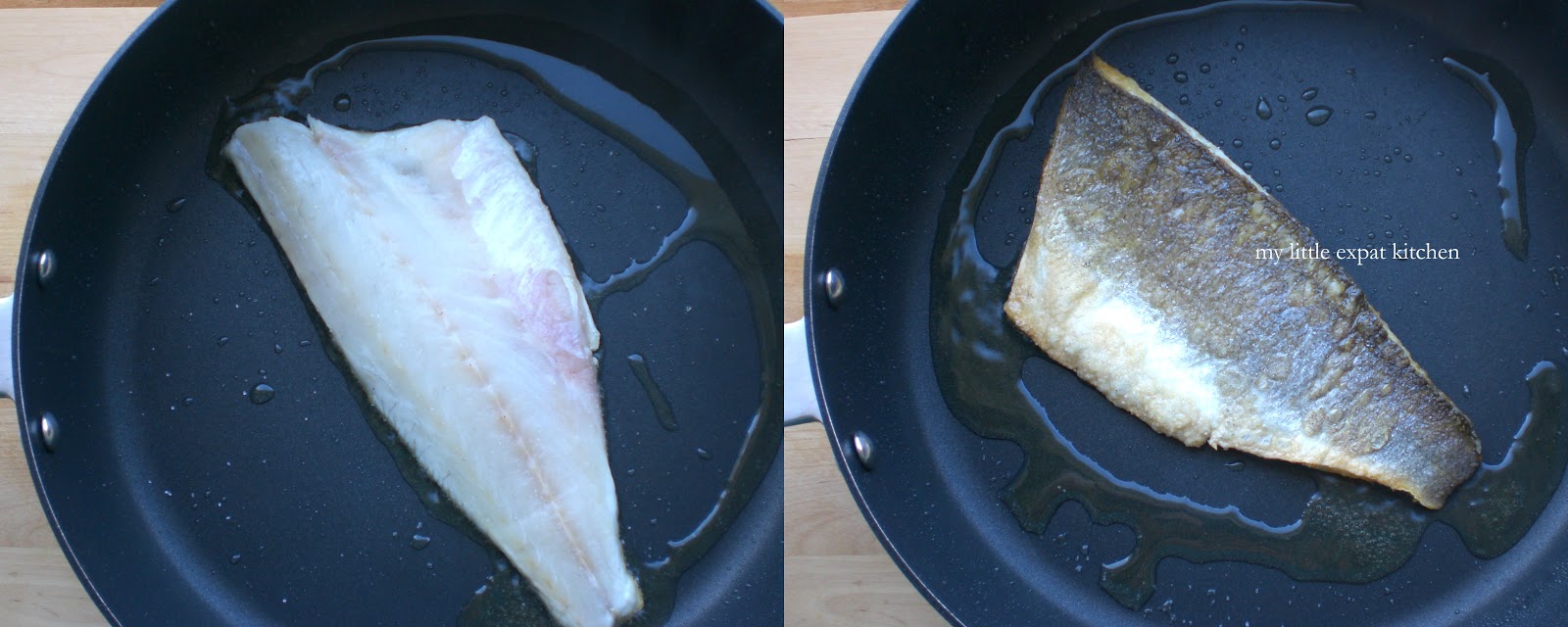
In a large, non-stick frying pan add enough olive oil to just cover the bottom of the pan. Heat over high heat and when the oil starts to shimmer, season the fish with sea salt on both sides and add them, skin side down, to the pan. (I cooked two fish fillets at a time.)
Fry the fish for 2 minutes, until the skin crisps up, pressing it lightly down with a spatula so it doesn't curl up. Then turn the fish over and cook for 1 minute, pressing gently with a spatula and being careful not to break it up. Remove the fillets from the pan and place them straight onto the plates.


Cut four 10 g-disks from the vanilla butter log and place each disk on top of each hot sea bass fillet. The butter will melt on top of the fish creating a light sauce.

If you want to be a little more cautious with the vanilla butter, you can add 5 g instead of 10 g on each fillet of fish or you can just rub the fish with the butter and don't allow all of it to melt onto the fish. The flavor will be lighter and subtler.


Jumat, 08 Juni 2012

For a summer day

I get bored quite easily with food, so I always try to switch things up, try new flavors and not eat the same thing day in day out. I essentially try to keep my palate on its toes. Even during weekdays, when everything is more hectic, I want the whole package. I want something delicious, nutritious and unique.


For me, good food is not only about flavor, even though that's the most important thing, but also about texture and looks. I'm a very visual person and if something doesn't look appetizing, I'm not keen to eat it.


Especially during the summer, the season when all things green are abundant and extremely tempting, there's no excuse to have anything less than spectacular meals. Fresh green peas, purple artichokes, white asparagus, yellow courgettes, red tomatoes; the color palette is limitless and the flavor palette is even more varied.


I have been in a constant courtship with green asparagus for over a month now and the wonderfully tasty green spears are working their magic on me. I can't get enough of them. I recently hinted about a recipe for asparagus pesto with fish and of course I had to share it with you.


The truth is, I never cared for the classic pesto, most probably because I don't like basil. Along with cilantro, they are my least favorite herbs. But give me any other kind of pesto and I'm a sucker for it. Rocket, parsley, mint and more recently, asparagus pesto.


There's nothing like the bright flavor of green asparagus paired with the pungent garlic, earthy pine nuts and the umaminess of parmesan to make my day. Draped over a nicely grilled, baked or pan-fried piece of firm-fleshed fish like salmon, it's nothing short of amazing.


Pan-Fried Salmon with Green Asparagus Pesto

The salmon, with its delicate sweetness, is the perfect pairing to the nutty, hearty green asparagus pesto, but you can also serve it with any other fish you like, or with chicken.
You better hurry up though, you don't want to miss the asparagus season which is nearing its end.

Instead of pan-frying the salmon, you can also bake it in aluminum foil. Season the salmon fillets with salt, coat them with enough pesto to cover the top and bake for 15-20 minutes in a preheated oven (200 degrees Celsius / 390 Fahrenheit).


Yield: 2 main-course servings / 1 cup of asparagus pesto

Ingredients

for the asparagus pesto
350 g fresh green asparagus, trimmed of woody stems (read in this post how to trim them)
25 g (2½ Tbsp) pine nuts
1 or 2 garlic cloves, depending on how much you like garlic, peeled and finely chopped
30 g (4 Tbsp) parmesan cheese, grated
Juice of ½ lemon, freshly squeezed
40 ml (2½ Tbsp) extra-virgin olive oil
1-2 Tbsp of the asparagus cooking liquid
Freshly ground black pepper
Salt

for the salmon
2 salmon fillets, skinless and boneless, 180-200 g each
60 ml (4 Tbsp) olive oil
Salt

Pine nuts, finely chopped, for sprinkling over the dish (optional)

Special equipment: colander, food processor, large skillet (preferably non-stick)


Preparation

for the asparagus pesto
Fill a large pot with water and bring it to the boil. Add a little salt and then add the trimmed asparagus. Boil for 8-9 minutes until they are very tender but not falling apart.
Keep 2-3 Tbsp of the cooking liquid and drain the asparagus in a colander. Run them under cold running water to stop them from cooking further and let them cool completely.

Cut them into 5 cm pieces and add them to your food processor. Add the pine nuts, garlic clove(s), grated parmesan, lemon juice, olive oil, 1 Tbsp of the asparagus cooking liquid and a little black pepper. Process well until you have a homogeneous mixture, and give it a taste. Add salt if you think it needs it, and if you find the pesto too thick for your liking, add a little more of the cooking liquid.


for the salmon
Bring the salmon to room temperature 10-15 minutes before cooking.
Pat the salmon fillets dry with kitchen paper and sprinkle them with salt on both sides.

Heat the olive oil in a large skillet over medium-high heat and when it starts to shimmer, add the salmon fillets. Pan-fry them for 4-5 minutes on one side, until they take on a golden brown color, and then turn them over and pan-fry them for a further 3-4 minutes, or until cooked to your liking. Take the fillets out of the pan and onto a plate covered with kitchen paper to absorb the extra oil.

Place the salmon fillets on two individual plates and serve immediately with the pesto on the side or on top of the fish. Sprinkle with finely chopped pine nuts (optional).

You can keep the pesto in the refrigerator, covered, for 1-2 days. It becomes thicker once refrigerated. When you want to serve it, give it a good stir.


More salmon recipes:
Salmon with pomegranate molasses glaze
Pan-fried salmon fillets with sautéed fennel and ouzo


Rabu, 15 Desember 2010

There are others like me out there, right?

I'm one of those people who during the Christmas holidays wear the crazy Santa hats and red antler hair pieces and call it fashionable.


I'm one of those people who sing carols till they drop while trimming the tree and sometimes even accidentally drop on the tree while caroling.


I'm one of those people who pretend to be excited when someone offers them a hot cup of Christmas cocoa when deep down inside all they really want is a glass of Scotch.


I'm one of those people who rush out on the afternoon of December 24 to buy all the gifts they said they had already bought weeks in advance.


I'm one of those people who occasionally tell a white lie during the holidays in order to make the ones they love happy.

"No (fill in name of friend/relative here), these cookies were delicious. Nah, that tooth was already chipped anyway"

"Yes (fill in name of niece/nephew/small cousin here), of course there is a Santa Claus"
(I'm not gonna be the one shattering that illusion. Someone else will do it eventually)

"Sure (grandma, grandpa, aunt etc) I love this jacket. Who knew 70's brown-green couch fabrics were back in style"


I'm one of those people who stay up late watching Christmas movies, eating a bowlful of caramel spiced popcorn and getting all teary-eyed and hopeful and believing that human nature is kind and everything is sweets and sugar.
And then, well, you know, I switch the channel to the news and I get a slap in the face.


I'm one of those people who prepare way too much cookie dough because they secretly want to stash it for late-night secret munching.


I'm one of those people who during the holidays (and other occasions) promise their guy a full-fat meal with lots of red meat (just like S likes it) and then make them fish.


There are others like me out there, right?


We're not talking about any kind of fish here though. We're talking about the almighty salmon. It is perhaps my favorite kind of fish and paired with my other favorite kind of food, rice, that was my idea of a perfect meal. Even though I caught S off guard with the fish, he came around once he tasted it. Besides, this was a pretty, pretty, pretty good meal. Salmon with a pomegranate glaze and Armenian rice pilaf.


The salmon is first marinated in olive oil, soy sauce, lime and lemon juice and then slathered with a combination of homemade pomegranate molasses, honey, fresh ginger, garlic and lime zest. The salmon is baked in the oven on high heat and a few minutes later, you are presented with a flavorful and aromatic dish that is full of sweetness from the salmon, with zesty and tangy undertones from the marinade and a sweet sourness from the pomegranate molasses. My mouth is watering as I'm writing the words and recall the taste.


The Armenian rice pilaf was a complete and utter savory delight. Made with basmati rice and vermicelli, lots of butter and pine nuts, it had an incredibly rich, buttery, earthy flavor and a wonderfully crisp texture. The final sprinkling of fresh mint and a few pomegranate seeds elevated the dish, freshened it up and rounded up all the flavors.


This glazed salmon and Armenian rice pilaf are ideal dishes to prepare for a holiday dinner with friends or family or for a dinner for two. Accompanied by a Pinot Grigio and a green salad you'll have a festive, delicious dinner without having to slave in the kitchen for hours. Plus, with all the turkeys and hams and beef going around during the holidays, this is a rather welcomed change, don't you think?


Salmon with Pomegranate Molasses Glaze
Adapted from Lulu Powers

This salmon dish is very easy to prepare and cook. You need to marinate the fish for 1 ½ hours and then bake it in the oven for 7-8 minutes and you're done.

I generally use good quality, low-sodium soy sauce since the taste is the same as that of regular soy sauce but it has less salt (which is only a plus) but you can surely use normal soy sauce. Just use less salt in the marinade.

You can serve the salmon either with the Armenian rice (see recipe below) or with a simple basmati or brown rice.


Yield: 4 servings

Ingredients

for the marinade
30 ml (2 Tbsp) soy sauce (preferably low-sodium)
15 ml (1 Tbsp) extra virgin olive oil
15 ml (1 Tbsp) lemon juice, freshly squeezed
15 ml (1 Tbsp) lime juice, freshly squeezed
15 ml (1 Tbsp) honey
2 medium-sized garlic cloves, unpeeled and lightly crushed
1 ½ tsp fresh ginger, finely grated
½ tsp salt
½ tsp freshly ground white pepper

for the glaze
30 ml (2 Tbsp) pomegranate molasses
15 ml (1 Tbsp) honey
15 ml (1 Tbsp) soy sauce (preferably low-sodium)
1 medium-sized garlic clove, finely minced
1 ½ tsp fresh ginger, finely grated
1 ½ tsp lime zest

4 salmon fillets, skinless and boneless, 180-200 g each
Salt
Freshly ground white pepper

10 g fresh mint, chopped
Pomegranate seeds from one pomegranate

Special equipment: grater, large shallow dish, large rimmed baking pan, cling film, pastry brush


Preparation
Rinse the salmon fillets under cold running water.

for the marinade
In a large shallow dish, combine the soy sauce, extra virgin olive oil, lemon and lime juice, honey, crushed garlic, ginger, salt and pepper.
Add the salmon fillets to the dish, coating both sides with the marinade.
Cover the dish with cling film and refrigerate for 1 -1 ½ hours. Turn the salmon fillets every 20 minutes or so.


Preheat your oven to 220 degrees Celsius.


for the glaze
In a medium-sized bowl, add the pomegranate molasses, honey, soy sauce, garlic, ginger and lime zest. Whisk everything together.


Take salmon out of the refrigerator and place fillets onto a large, rimmed baking pan. Season each fillet with a little salt and a little freshly ground white pepper. Using a pastry brush (or even your hands if you don't have one), brush the fillets with half of the glaze.
Place pan on the middle rack of the oven and bake salmon fillets for 5 minutes, until they are slightly browned.
Take pan out of the oven and brush the fillets with the remaining glaze. Return to the oven and bake for further 3 minutes, until the fish is richly glazed and almost cooked through.

Serve the salmon
Transfer fillets to the plate and garnish with the chopped fresh mint and the pomegranate seeds. Serve immediately along with the Armenian rice (see recipe below) or with any other side dish you have prepared.


Homemade Pomegranate Molasses

This is an extremely easy way to make homemade pomegranate molasses. The taste is sweet but a little tart as well.
You can use it not only as an ingredient for glazing salmon but also beef and pork. You can also use it on top of waffles, pancakes and of course, ice cream.


Yield: 250-300 ml

Ingredients
950 ml fresh pomegranate juice (or bottled 100% pomegranate juice)
190 g sugar
60 ml lemon juice, freshly squeezed and strained

Preparation
In a medium-sized, heavy-bottomed saucepan, add the sugar, lemon juice and pomegranate juice. Bring to a simmer over medium-high heat, stirring continuously with a rubber spatula until the sugar dissolves. Taste the juice and if you want to add more sugar, do it at this stage. Add the sugar and stir continuously until it dissolves.
Once the juice begins to simmer, reduce the heat to medium or just enough to maintain a simmer. Every now and then remove with a spoon the foam that is gathered on top of the simmering juice.
Simmer for 1 - 1 ½ hours or until the juice has the consistency of syrup. You will end up with about 1 ¼ cups pomegranate molasses.

As the pomegranate molasses cools down, it will become thicker.

Pour the molasses in a glass jar (preferably sterilized) and put it in the refrigerator once it cools completely.

You can keep it in the fridge for up to 4 months.


Armenian Rice Pilaf
Adapted from Lulu Powers

This rice dish is extremely versatile and will serve you well during this holiday season. It is very easy to prepare and you can serve it not only with the glazed salmon but with lamb, pork and beef main dishes.

If you' re looking for a perfectly delicious and not aggressive in taste side dish, this is it.


Yield: 6 servings

Ingredients
400 g basmati rice
90 g unsalted butter
45 g vermicelli or angel-hair pasta, broken into 1 ½-2 cm lengths
900 ml good quality chicken or vegetable stock, warmed
40 g pine nuts
½ tsp salt
Freshly ground white pepper
15 g fresh mint, chopped
Pomegranate seeds from one pomegranate

Special equipment: large sieve


Preparation
Place basmati rice in a large sieve and rinse it well under cold running water, until the water running through is no longer cloudy. Put sieve over a bowl and let rice dry.

In a large, heavy-bottomed pan, melt the butter over medium-high heat.
Add the vermicelli or angel-hair pasta and the pine nuts and sauté them in the butter until they're golden brown, for 3-5 minutes. The butter may foam while you do this.
Add the rice and stir it around in order to get coated with the butter.
Add the warmed chicken stock, the salt and a generous amount of freshly ground white pepper. Stir everything around and once the stock comes to the boil, turn heat down to low, cover the pan with the lid and let rice cook for about 25 minutes, until the rice is tender yet crispy and all the liquid is absorbed.
Check the rice after 20 minutes to make sure it doesn't overcook.

When rice is cooked, take it off the heat and fluff it well with a fork. Cover the pan and let the rice stand for 20 minutes.

Stir in half of the chopped fresh mint and serve the pilaf either in individual dishes or in a large serving bowl. Garnish with the rest of the mint and sprinkle with pomegranate seeds on top.

If you have any rice left, you can certainly eat it the next day. It is equally flavorful.