Soutzouki and pastourmas have always been staples in my fridge in Greece. Here in Holland they’re impossible to find and even if I do manage to scare up something that resembles any one of them, their taste and quality is a far cry from what I’m used to.

One of the things I brought back with me from Greece, besides the good supply of chocolates, are these two delicacies. Soutzouki, as I’ve previously mentioned, is a spicy fresh sausage made nine out of ten times with beef meat, and pastourmas is seasoned, spicy air-cured beef.

The best way to eat these two is to simply slice them and serve them with a chunk of fresh bread and a shot glass of ouzo; they make the perfect meze on a warm summer evening. On the other hand, a wonderful way to savor them is adding them to a peinirli.

The Greek word Peinirli (Πεϊνιρλί) derives from the Turkish word Peynirli which translates to “with cheese” (peynir means cheese in Turkish). Peinirli is a boat- or rather canoe-shaped yeasted bread, similar to the Turkish pide but larger, with a dough that’s soft inside and beautifully crusty but not hard on the outside.

Peinirli is beloved by all Greeks, especially those whose families come from Constantinople and Smyrni as mine, but also Pontus. When Greeks from Pontus (the Greek name for the Turkish Black Sea south coast) arrived in Greece in the 1920’s after the population exchange between Greece and Turkey, some of them settled in Drosia, an Athenian suburb, and opened restaurants that served their specialty, the peinirli. Till today, Athenians make the almost one-hour trip by car to Drosia to have the best peinirli in Greece.

One more thing that makes peinirli unique and delicious is its fillings, with the traditional one being the Greek kaseri cheese that sizzles in the middle of the risen baked dough, and the butter that needs to be added as soon as the little doughy boat comes out of the oven so it can melt gloriously on top of said cheese.

Peinirli can have various other fillings like minced meat, eggs, tomato, ham, sausages and many more. In my family, what constitutes a traditional peinirli is one filled with soutzouki or pastourma, cheese and tomato.
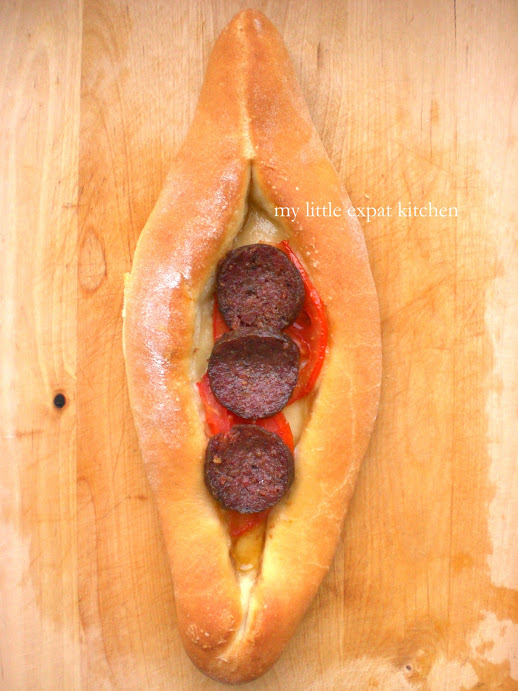
The pungent and spicy flavor of both pastourma and soutzouki paired with the rich cheese and fresh tomato make for a tasty treat. Both these delicacies are quite heavy when cooked though, so tread cautiously. Try not to eat too much.

No matter what kind of filling you end up using in your peinirli, I do hope you enjoy this classic Greek yeasted savory delight.
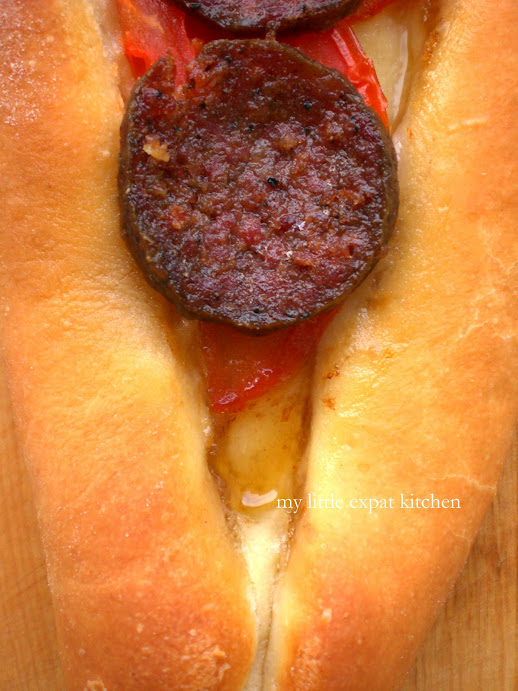
Peinirli
Peinirli is quite substantial fare and can be enjoyed as a main meal, much like pizza, or as a snack cut in smaller pieces.
If you can’t find soutzouki, you can use any other kind of sausage you want. Same with pastourmas, just substitute with another type of spicy air-cured beef.
If you have a pizza stone, then by all means use it to bake the peinirli. The result will be excellent.
Semolina flour is finely milled semolina (it’s not fine semolina but semolina that is so finely milled that has the texture of flour). In Greece, this flour is widely used for bread and all kinds of yeasted savory doughs. If you can’t find it, use strong bread flour.

Yield: 8 peinirli
Ingredients
for the dough
300 g all purpose flour, plus extra for sprinkling your work surface
200 g semolina flour (from durum wheat)
9 g instant dried yeast
1 tsp sea salt
½ tsp sugar
200 ml lukewarm water
150 ml lukewarm fresh whole milk
50 ml good quality olive oil, plus extra for greasing dough and bowl
for the cheese filling
Greek kasseri cheese or Swiss Emmentaler, grated
Unsalted butter, preferably sheep’s butter
for the pastourma or soutzouki filling
Pastourma, sliced
Soutzouki, sliced
Tomato, sliced
Greek kasseri cheese or Swiss Emmentaler, grated
Special equipment: box grater, stand mixer with dough hook attachment (optional), large baking sheet, baking paper, pizza stone (optional)
Preparation
In the bowl of your stand mixer or in a large bowl, add the flours, the yeast, sugar, salt (making sure it doesn’t come in contact with the yeast), the lukewarm water and milk, and the olive oil.
If you’re kneading in a stand mixer, attach the dough hook and knead for about 7 minutes, on the lowest speed, until the dough no longer sticks to the sides of the bowl, remains slightly moist and it is smooth and elastic. Empty it onto a lightly floured surface (use all–purpose flour for this) and knead it a little to see how it feels. It should feel a little sticky to the touch.
If you're kneading by hand, once you have mixed the ingredients together into a rough dough, take it out of the bowl and onto a clean surface and knead well. It'll take about 10 minutes. What you're aiming for is a soft and pliable dough that's sticking slightly to your hands and that remains moist but not overly so that you can’t knead it.
Note: Not all flours are the same, so if your dough is very wet, don't be afraid to add more flour (all-purpose flour). Add a little at a time though, testing the consistency of the dough. You don't want to end up with a stodgy, stiff dough. I find that with this dough, I always seem to add a little more flour so that it doesn’t stick too much (about 35 g more).
Shape the dough into a ball, lightly grease the bowl of your stand mixer (or a large bowl) as well as the dough ball with olive oil and place the dough inside the bowl. Cover the bowl with plastic wrap and place it in a warm place, allowing the dough to proof and double in size. It will take about 1 hour to proof, depending on how warm the room you leave it in is.
During the winter, I always leave my dough next to a working radiator. Not on top of it but on a chair and right in front of it.


Once the dough has proofed, take it out of the bowl and knead it for a couple of seconds just to deflate it a bit. It should feel smooth, pliable and soft. Divide the dough into 8 equal pieces (around 115 g each) and shape into balls. Oil the balls (so they don’t stick to one another) and place them in the bowl after you oil it again. Cover the bowl with plastic wrap and place it in a warm place, allowing the balls of dough to proof until almost doubled in sized. It will take 30-40 minutes.
Preheat your oven to 225 degrees Celsius / 435 Fahrenheit.
If you have a pizza stone, place it on the lower rack of the oven to preheat as well. If not, prepare your baking sheet by lining it with baking paper.
Once the dough balls have proofed, take each one and place it on a floured surface and flatten it into an oblong shape (about 26x13 cm). Take the bottom edge and fold it (see photo below). Then take the upper edge and fold it (see photo). Seal the two pointy ends by pressing them together (where the two folded parts overlap). If it’s difficult because of the flour, add a little water with your fingertips between the two pieces of dough and press them together to seal. You will have a boat-shaped dough with elevated sides that’ll keep your filling inside.
Continue with the rest of the dough balls. My oven is small so I can fit only three at a time. While the first batch is baking I shape the rest.


Place the shaped peinirli onto the prepared baking sheet (or onto the pizza stone that you have sprinkled with a little flour), prick the inside of the “boat” (where you’ll later add your filling) with a fork so it doesn’t puff up and place on the lower rack of your preheated oven. Bake for 10 minutes, until they begin to color. Take them out and lower the heat to 185 degrees Celsius / 365 Fahrenheit.
Fill the peinirli with the ingredients of your choice. If you’re using cheese, add a generous amount in the middle. If you’re using the soutzouki or pastourma, add a couple of slices of tomato at the bottom, followed by a couple of slices of soutzouki or pastourma and then some grated cheese on top. Be careful not to overflow the boat, no pun intended.
Return the peinirli in the oven and bake for a further 10 minutes, until the cheese melts but doesn’t brown. It shouldn’t form a crust.
Take them out of the oven and if you made the cheese peinirli, add a couple of knobs of butter on top to melt.
Serve immediately.


One of the things I brought back with me from Greece, besides the good supply of chocolates, are these two delicacies. Soutzouki, as I’ve previously mentioned, is a spicy fresh sausage made nine out of ten times with beef meat, and pastourmas is seasoned, spicy air-cured beef.

The best way to eat these two is to simply slice them and serve them with a chunk of fresh bread and a shot glass of ouzo; they make the perfect meze on a warm summer evening. On the other hand, a wonderful way to savor them is adding them to a peinirli.

The Greek word Peinirli (Πεϊνιρλί) derives from the Turkish word Peynirli which translates to “with cheese” (peynir means cheese in Turkish). Peinirli is a boat- or rather canoe-shaped yeasted bread, similar to the Turkish pide but larger, with a dough that’s soft inside and beautifully crusty but not hard on the outside.

Peinirli is beloved by all Greeks, especially those whose families come from Constantinople and Smyrni as mine, but also Pontus. When Greeks from Pontus (the Greek name for the Turkish Black Sea south coast) arrived in Greece in the 1920’s after the population exchange between Greece and Turkey, some of them settled in Drosia, an Athenian suburb, and opened restaurants that served their specialty, the peinirli. Till today, Athenians make the almost one-hour trip by car to Drosia to have the best peinirli in Greece.

One more thing that makes peinirli unique and delicious is its fillings, with the traditional one being the Greek kaseri cheese that sizzles in the middle of the risen baked dough, and the butter that needs to be added as soon as the little doughy boat comes out of the oven so it can melt gloriously on top of said cheese.

Peinirli can have various other fillings like minced meat, eggs, tomato, ham, sausages and many more. In my family, what constitutes a traditional peinirli is one filled with soutzouki or pastourma, cheese and tomato.

The pungent and spicy flavor of both pastourma and soutzouki paired with the rich cheese and fresh tomato make for a tasty treat. Both these delicacies are quite heavy when cooked though, so tread cautiously. Try not to eat too much.

No matter what kind of filling you end up using in your peinirli, I do hope you enjoy this classic Greek yeasted savory delight.
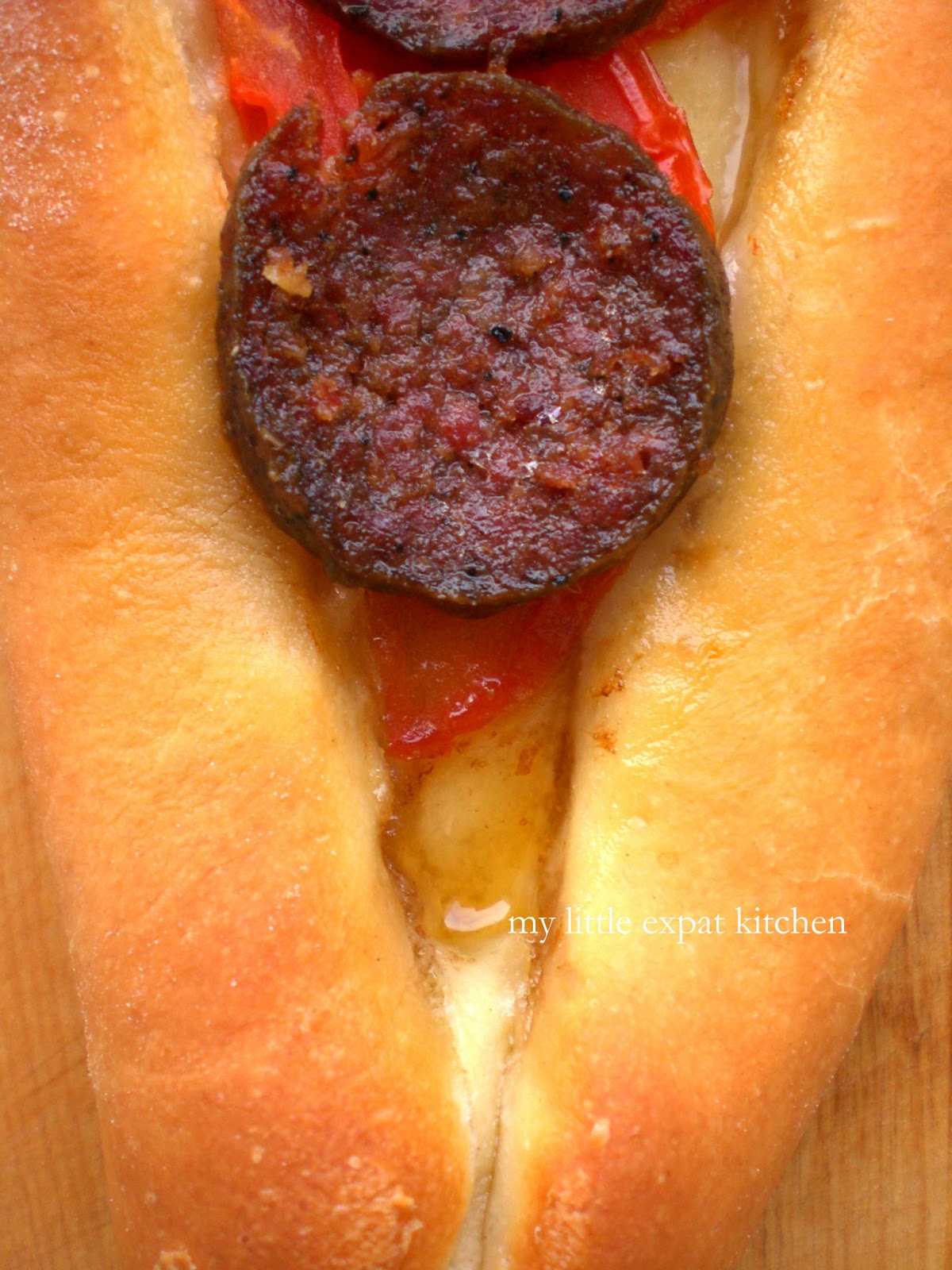
Peinirli
Peinirli is quite substantial fare and can be enjoyed as a main meal, much like pizza, or as a snack cut in smaller pieces.
If you can’t find soutzouki, you can use any other kind of sausage you want. Same with pastourmas, just substitute with another type of spicy air-cured beef.
If you have a pizza stone, then by all means use it to bake the peinirli. The result will be excellent.
Semolina flour is finely milled semolina (it’s not fine semolina but semolina that is so finely milled that has the texture of flour). In Greece, this flour is widely used for bread and all kinds of yeasted savory doughs. If you can’t find it, use strong bread flour.

Yield: 8 peinirli
Ingredients
for the dough
300 g all purpose flour, plus extra for sprinkling your work surface
200 g semolina flour (from durum wheat)
9 g instant dried yeast
1 tsp sea salt
½ tsp sugar
200 ml lukewarm water
150 ml lukewarm fresh whole milk
50 ml good quality olive oil, plus extra for greasing dough and bowl
for the cheese filling
Greek kasseri cheese or Swiss Emmentaler, grated
Unsalted butter, preferably sheep’s butter
for the pastourma or soutzouki filling
Pastourma, sliced
Soutzouki, sliced
Tomato, sliced
Greek kasseri cheese or Swiss Emmentaler, grated
Special equipment: box grater, stand mixer with dough hook attachment (optional), large baking sheet, baking paper, pizza stone (optional)
Preparation
In the bowl of your stand mixer or in a large bowl, add the flours, the yeast, sugar, salt (making sure it doesn’t come in contact with the yeast), the lukewarm water and milk, and the olive oil.
If you’re kneading in a stand mixer, attach the dough hook and knead for about 7 minutes, on the lowest speed, until the dough no longer sticks to the sides of the bowl, remains slightly moist and it is smooth and elastic. Empty it onto a lightly floured surface (use all–purpose flour for this) and knead it a little to see how it feels. It should feel a little sticky to the touch.
If you're kneading by hand, once you have mixed the ingredients together into a rough dough, take it out of the bowl and onto a clean surface and knead well. It'll take about 10 minutes. What you're aiming for is a soft and pliable dough that's sticking slightly to your hands and that remains moist but not overly so that you can’t knead it.
Note: Not all flours are the same, so if your dough is very wet, don't be afraid to add more flour (all-purpose flour). Add a little at a time though, testing the consistency of the dough. You don't want to end up with a stodgy, stiff dough. I find that with this dough, I always seem to add a little more flour so that it doesn’t stick too much (about 35 g more).
Shape the dough into a ball, lightly grease the bowl of your stand mixer (or a large bowl) as well as the dough ball with olive oil and place the dough inside the bowl. Cover the bowl with plastic wrap and place it in a warm place, allowing the dough to proof and double in size. It will take about 1 hour to proof, depending on how warm the room you leave it in is.
During the winter, I always leave my dough next to a working radiator. Not on top of it but on a chair and right in front of it.


Once the dough has proofed, take it out of the bowl and knead it for a couple of seconds just to deflate it a bit. It should feel smooth, pliable and soft. Divide the dough into 8 equal pieces (around 115 g each) and shape into balls. Oil the balls (so they don’t stick to one another) and place them in the bowl after you oil it again. Cover the bowl with plastic wrap and place it in a warm place, allowing the balls of dough to proof until almost doubled in sized. It will take 30-40 minutes.
Preheat your oven to 225 degrees Celsius / 435 Fahrenheit.
If you have a pizza stone, place it on the lower rack of the oven to preheat as well. If not, prepare your baking sheet by lining it with baking paper.
Once the dough balls have proofed, take each one and place it on a floured surface and flatten it into an oblong shape (about 26x13 cm). Take the bottom edge and fold it (see photo below). Then take the upper edge and fold it (see photo). Seal the two pointy ends by pressing them together (where the two folded parts overlap). If it’s difficult because of the flour, add a little water with your fingertips between the two pieces of dough and press them together to seal. You will have a boat-shaped dough with elevated sides that’ll keep your filling inside.
Continue with the rest of the dough balls. My oven is small so I can fit only three at a time. While the first batch is baking I shape the rest.


Place the shaped peinirli onto the prepared baking sheet (or onto the pizza stone that you have sprinkled with a little flour), prick the inside of the “boat” (where you’ll later add your filling) with a fork so it doesn’t puff up and place on the lower rack of your preheated oven. Bake for 10 minutes, until they begin to color. Take them out and lower the heat to 185 degrees Celsius / 365 Fahrenheit.
Fill the peinirli with the ingredients of your choice. If you’re using cheese, add a generous amount in the middle. If you’re using the soutzouki or pastourma, add a couple of slices of tomato at the bottom, followed by a couple of slices of soutzouki or pastourma and then some grated cheese on top. Be careful not to overflow the boat, no pun intended.
Return the peinirli in the oven and bake for a further 10 minutes, until the cheese melts but doesn’t brown. It shouldn’t form a crust.
Take them out of the oven and if you made the cheese peinirli, add a couple of knobs of butter on top to melt.
Serve immediately.


