Jumat, 07 Mei 2010

Tipsy pork

The past couple of weeks, South Holland experienced a welcomed streak of heat and sunshine. Almost all of the month of April was filled with sunny days and you couldn't go out the door without your sunglasses and a considerable cut down on clothing layers. No more jackets with extra padding for warmth retention, no more scarves. There was not a cloud in sight. I was honestly dumbfounded. I could actually take some decent photographs of my food with all that natural light.


The Dutch were happy with a capital H. Sunshine is an event here. They swarmed to the nearest parks and public gardens to sunbathe and play games. Many of my Dutch neighbors were exhibiting most of their body parts- some I needn't see- to the sun, taking out into their backyards and balconies their lounge chairs and calling friends over to enjoy a sun-filled afternoon and share a couple of drinks. Paired with Queen's Day last Friday, which is a national holiday here in The Netherlands, the Dutch were walking on air.


So, right when I thought that spring was here to stay, a sudden wave of heavy rain and cold weather came to prove me and everyone else wrong and to remind me that I'm now living in northern and not southern Europe. Ok, ok, I get it! Sudden weather changes are the norm around here. Since last weekend, storms are raging, winds are howling, temperature has dropped by 10 or more degrees Celsius and I had to put my flip flops back in storage and take out, once again, my sheepskin boots.


All this came just as I was starting to daydream of foreign, exotic places and just as I was starting to get cravings for spring-summery food, like avocado and grilled turkey salads or seafood linguine. It will be a while before I make these dishes. My cravings have just shifted to more weather-appropriate food. And what's more appropriate for cold weather than a stew?


I had so many recipes for meat stews to choose from. Greeks adore stews. Chicken, veal, pork, goat, lamb stews are being cooked every single week of the year, all year round. They're not confined to "winter eating". They are an integral part of the Greek diet and there is a multitude of ways to prepare them. But my choice was not a Greek stew, although many such recipes will be coming later on, I promise. I went with something slightly different; a pork stew with dried fruit and dark beer.


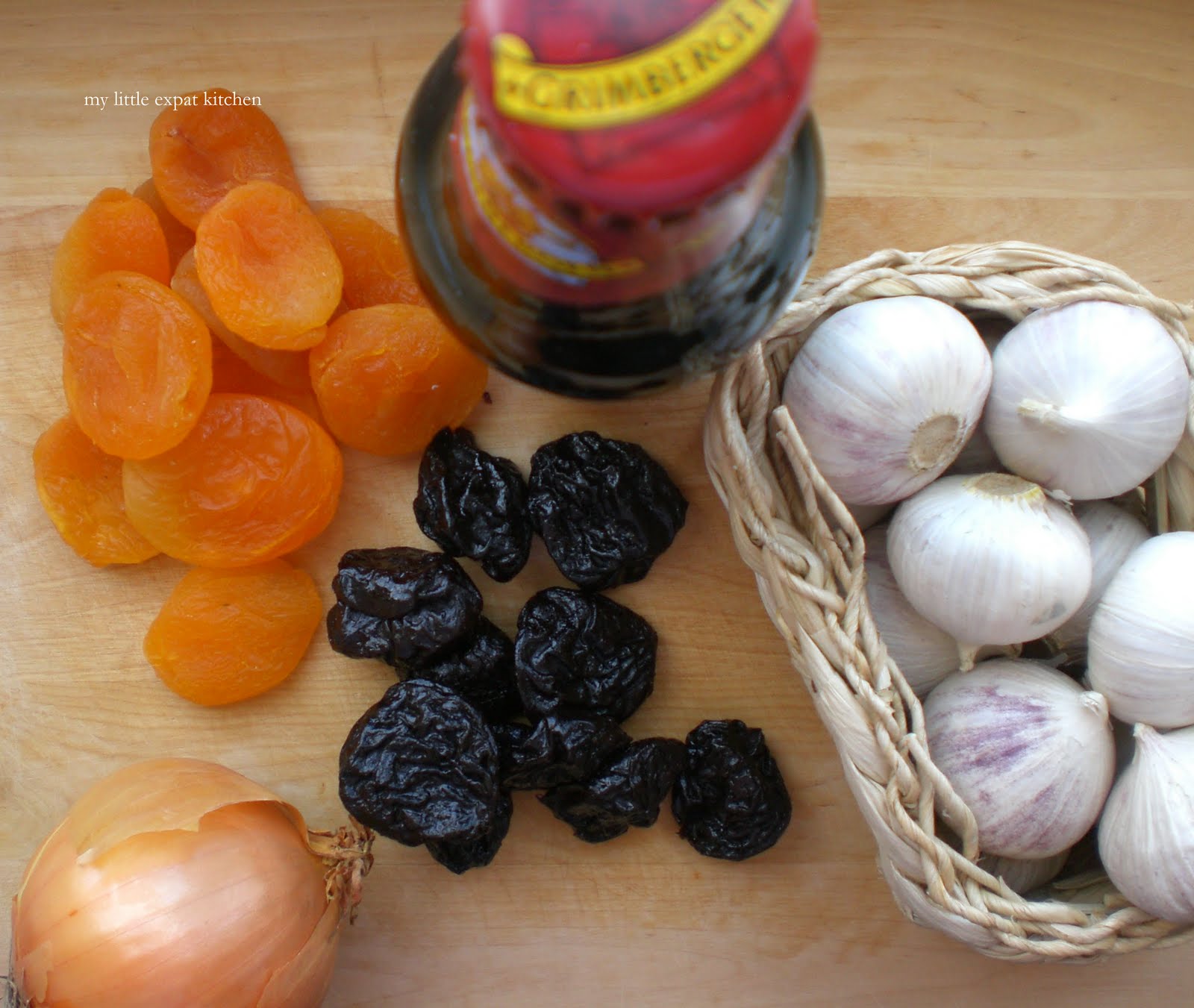
The first time I made this stew I was completely taken by its unique flavor and the richness of its sauce. Bite-sized pieces of pork are first nicely browned in a Dutch-oven on a stove top, in a mixture of olive oil and butter. Then the onions and woody garlic are sautéed in the meat juices until they become soft and then you simply add the rest of the ingredients, like dried fruit, dark beer and Dijon mustard in the pan and put it straight into the oven for an hour and a half or so. It's so simple, so easy, such an unassuming dish but with such an intense flavor.


The sweet dried apricots and prunes along with the apple jelly, give a sweet, fruity taste to the pork and the sharp Dijon mustard and bitter dark beer provide some delicate sour notes to render a balance of flavors. The aromatic cinnamon and pungent ground coriander add depth and a hint of spice to the dish, making it extremely fragrant. The meat is tender and succulent and the sauce is dense and glossy; impossible to resist.


There are several side dishes with which to serve this stew. Fluffy mashed potatoes is one of them and it's a delicious choice. Serve the stew with lots of sauce, mashed potatoes on the side, and make sure you have plenty of warm, crusty bread around to mop up all the lovely, tasty juices.
Slightly reminiscent of Asian recipes, this dish pairs perfectly with jasmine rice or brown rice. Jasmine rice, which is Thai rice, gives an exotic touch to the dish and its nutty aroma complements the sweetness of the pork. Serve the stew on top, not with a lot of juices though so that the rice can retain its granular texture.
Another option is to serve it with French fries or even potatoes boiled in water, a splash of olive oil and a little salt and pepper.
An assortment of fresh green leaves would make the best choice for a salad to accompany each of the aforementioned dishes.


Accompany this stew with the same beer that you used to cook the pork with or, if you prefer wine, with a chilled bottle of fruity Chardonnay. The beer I used was Grimbergen, a double beer that is brewed in Belgium for the last 882 years. It is a full-bodied beer with a dark, burgundy color and a strong malt flavor with a spicy finish that really complements the fruitiness of the stew. Brown Leffe is another excellent option. You can of course use any other kind of dark beer or ale you prefer.


Pork Stew with Dried Fruit and Dark Beer
Adapted from epicurious

As with every other recipe, I changed this one a bit also. Altered and adjusted quantities, substituted ingredients for better results, added my own little touches.
I'm very particular about my meat. I prefer lean cuts, without a whole lot of fat on them, even for stews. The original recipe calls for pork shoulder but I opted for pork fillet with a fair amount of fat on it to give it some extra taste and to keep it tender. You can use pork shoulder if you wish although it doesn't make a huge difference in my opinion.

I used apple jelly that I made about a month ago but apple jam will work as well. Jellies are made from the juice of fruit only whereas jams are made using the whole fruit, often with seeds left in them. So if you use jam, just avoid adding whole chunks of apple to the stew.


Yield: 4-5 servings

Ingredients
1 kg pork fillet*, cut into small cubes (3 x 3 cm)
2 medium-sized onions, chopped
3 large garlic cloves, minced
3 Tbsp olive oil
1 heaped Tbsp unsalted butter
2 Tbsp all-purpose flour
350 ml dark beer or ale
1 1/2 Tbsp apple jelly or jam
450 ml chicken stock
3/4 tsp ground coriander
1/4 tsp ground cinnamon
1 1/2 Tbsp Dijon mustard
100 g dried apricots, chopped (plus extra for garnish optional)
100 g dried, pitted prunes, chopped
Salt
Freshly ground black pepper
Parsley, chopped, for sprinkling over the dish (optional)

Special equipment: a large Dutch-oven**

Preparation
Preheat your oven to 175 degrees Celsius.

Put butter and olive oil in a Dutch-oven and heat over medium-high heat. When the butter melts, add enough pork pieces to cover 2/3 of the bottom of the pan (do not crowd the pan, otherwise the pork will get stewed rather than browned) and cook them, stirring occasionally, for about 5 minutes, until they brown on all sides. Remove them from the pan with the help of a slotted spoon and keep them in a bowl. Add a second batch of pork pieces to the pan and repeat the same process until all 1 kg of pork has been nicely browned. Leave bowl with browned pork pieces aside.

Add the chopped onions and garlic to the same pan and sauté them, stirring occasionally, for about 5 minutes, until they become soft and take on a light golden color.

Add the flour to the onions and garlic and stir for 3 minutes.
Pour in the chicken stock and dark beer and add the Dijon mustard, apple jelly, cinnamon, coriander, salt and pepper. Stir everything around until mustard, apple jelly and flour have dissolved and bring mixture to the boil.
Then return pork pieces back to the pan along with any cooking juices collected in the bowl.
Stir in the chopped dried apricots and prunes, cover Dutch-oven and put it on the lower rack of the oven.

Bake for 1 hour and 20 minutes and then remove the lid and bake for a further 20 minutes, until pork is tender and excess liquid has evaporated, leaving you with a rich sauce.

Remove pan from the oven and check the seasoning, adding more salt or pepper if needed.

Serve stew along with your desired side dish, sprinkling some parsley on top (optional).
You can also finely chop some dried apricots and sprinkle them all over the dish to make it more colorful (optional).

The stew is delicious when served straight out of the oven but keep in mind that it has a deeper, fuller flavor the following day.


* Don't trim the fat off the fillet.
**In case you don't have a Dutch-oven (the one I have is also called a French-oven), which is a pan that can be used both on the stove top and in the oven, you will either need a pan with similar qualities or you can first use a large enough pan to brown the pork and mix all the ingredients in, and then transfer everything to a casserole/pot/stoneware-bakeware with a lid that can go in the oven.

Jumat, 30 April 2010

South American Way

I have traveled to numerous countries in and around Europe but I have never traveled farther than that. There as so many places I want to see, cultures I want to experience, so many people I want to cross paths with. Traveling the world is a lifelong dream of mine, one that one day I hope to fulfill. I will surely need quite a lot of money though to do that, so I don't bet on it happening in the next decade or so.


Traveling is an experience that can ultimately change your perspective and view of life and of the world around you. An experience that can drag you out of your microcosm and introduce you to new ways of living, different ideas, possibilities and realities. Learning about other people, their customs and traditions, opens your mind and makes you more aware of the importance of diversity as well as individuality. I yearn for that kind of experience.


South America is a continent that really intrigues me and that I'm very eager to visit. I want to see the 13,000 year old stenciled images of hands in the Cueva de los Manos (Cave of the Hands) in Argentina, I want to see Machu Picchu, referred to as The Lost City of Incas, in Peru, I want to see the view of Rio de Janeiro from the Corcovado mountain and dance in a South American Way in Brazil, I want to navigate down the Orinoco river in Venezuela, I want to immerse myself deep in the Chilean wine country, tasting the wonderful wine it has to offer along the way.


Naturally I want to experience South American food in all its glory and exoticism. I want to eat ceviche, which is bite-sized pieces of raw fish or seafood marinated in citrus juices, salt and other seasonings, usually chilies. As the proper carnivore that I am, I want the complete asado experience in Argentina. Asado is a South American way of cooking different cuts of meat, mainly beef, in a grill or an open fire. I want to taste a feijoada in Brazil which is a bean, beef and pork stew. I want to get in touch with my inner vegetarian and devour authentic empanadas, which is stuffed pastry with lots of yummy vegetables. I want to walk the streets of Ecuador with a tamal in my hand, which is a packet of corn dough with a savory filling that is wrapped in banana leaves or corn husks and is either steamed or boiled. For dessert I think I will go with dulce de leche. Yeah, that sounds about right.


Dulce de leche. I love the way it rolls off the tongue. But what is it? Its name literally means milk candy and it is a thick caramel cream sauce. No, correction, it is a thick caramel cream sauce to die for.
I didn't discover dulce de leche by eating it in some little parador (restaurant) by the beach in Uruguay. No, the way I discovered it, was completely and utterly pedestrian. I was watching an Australian cooking show featuring South American recipes (that's one of the ways to have a culinary travel around the world) and I was smitten by the creamy caramel delight that the woman in the show was preparing and that she called manjar blanco, which I later found out is another name for dulce de leche. Oh, cajeta is another name for it too, and confiture de lait is how the French call it.


There are many ways of preparing dulce de leche though I've only tried one of them so far. You can use the painstaking method of stirring a mixture of milk and sugar in a pan for several hours until it becomes thick and creamy, the easier method of pouring sweetened condensed milk in a baking dish and cooking it in the oven until it's caramelized or, the easiest way of them all and my personal favorite, of simply boiling an unopened can of sweetened condensed milk in a pan, after you've made a couple of holes at the top (we don't want any explosions happening now, do we?) and leaving it in simmering water for 2-3 hours until it thickens. You need to check on it and add more water but it definitely beats the 3-hour stirring method.


Dulce de leche can be eaten just like that, out of the jar or drizzled on top of ice cream and pies but for me, right now, this is not enough. I need to take it a little further. I'm not content with just dulce de leche, I want something more luscious, I want a bit of variety, a bit of pizazz. I want the combination of dulce de leche, chocolate, and biscuit. And I found it all in this recipe. A mouthwatering recipe of a delicious dessert, candy, sweet, however you wanna call it.


By adding egg yolks, cream and dark chocolate to the caramel sauce, you transform the dulce de leche to a thicker, richer, deep-flavored chocolate-caramel cream that is so addictive you can't even fathom it. The shortbread crust makes an amazingly tasty and crumbly biscuit to rest the cream upon, creating a harmonious contrast of textures and the light sprinkling of fleur de sel (hand-harvested sea salt) on top completes the picture, creating a harmonious contrast of flavors.


Let me be totally honest here. This dessert is not an innocent one. Firstly, it takes a long time to prepare, secondly, it is full of calories and lastly, it's not the healthiest of sweets out there but it is one of the most exquisite and tasteful ones. At least to me it is. You have to make your own and weigh in on this.


I like cutting it into two-bite or even one-bite sized pieces because of its richness. When you offer a piece to someone, they will immediately get a whiff of caramel blended with a chocolate aroma. When they put it into their mouth, the real ride will begin. The crunch of the crumbly and buttery biscuit along with the scrumptious caramel cream, make the best first impression. The rich dark chocolate flavor hits first, accompanied by the subtle sharpness of the fleur de sel that balances the sweetness of it all. Finally, they'll sense the milky caramel and they'll be left with an aftertaste of buttery and caramel-y enchantment. They'll want more and more and so will you. It is worth the effort and the calories, believe me.


Bars of Chocolate Dulce de Leche with Shortbread Crust and Fleur de Sel
Adapted from Gourmet

It is best that you prepare this dessert during the weekend as it is rather time-consuming to make. You can make ahead the dulce de leche, keep it in the fridge and make the dessert another day.
I would advise you to use good quality dark chocolate for better results and make sure you use sweetened condensed milk for the dulce de leche and not evaporated milk. They are not the same.
I suppose you can buy ready-made dulce de leche, though I've never found or even looked for it myself. Making your own is by far better.
The recipe calls for 310 g of dulce de leche. I used a 400 g milk can which left me with 370 g of dulce de leche. You can certainly use a larger can, keeping the rest of the dulce de leche for later use.
I love what the addition of fleur de sel has to offer to the flavor of this dessert but it is great even without it. After all, it's a matter of personal taste. So feel free not to use it if you don't fancy it.


Yield: 35 bars / 370 g of dulce de leche

Ingredients

for dulce de leche
one 400 g can of sweetened condensed whole milk

for shortbread crust
115 g unsalted butter, softened, plus extra for greasing the pan
75 g soft light brown sugar
1/2 tsp salt
1/2 tsp pure vanilla extract
150 g all-purpose flour

for chocolate dulce de leche
310 g dulce de leche
250 ml cream, full fat
5 medium-sized egg yolks, at room temperature
145 g dark 60% good quality chocolate, finely chopped

Fleur de sel for sprinkling on top (optional)

Special equipment: a shallow square baking pan (22 x 22 cm)

Preparation

for dulce de leche
Remove the label from the milk can and make two small holes on opposite sides at the top, with the help of a can opener or with a clean nail and a hammer. This is extremely important so do not skip this step. If you don't pierce these holes there is a great possibility that the can will explode while boiling.

Place the can inside a small pot and fill it with water up to 1.5 - 2 cm from the top of the can. Do not fill it all the way up because while the water simmers, it might get inside the milk can through the small holes. Do not fill it lower than that because the milk at the upper part of the can will not thicken.

Turn heat on to high and once the water starts to boil, lower heat so that you can maintain the water at a simmer. The process of making the dulce de leche will take up to 3 hours. You will have to keep checking the level of the water in the pot every 15 minutes or so. The water must always be 1.5 - 2 cm from the top of the can so keep adding hot water, preferably from a water kettle, so that it doesn't stop simmering.

There will be some rattling noise during the boiling of the can so keep that in mind. Some milk will probably be coming out of the small holes while boiling. You can scoop it up with a spoon so that it doesn't drip into the simmering water.

After 3 hours have passed, turn the heat off and remove can from the pot using tongs. Place can on a rack to cool. Do not open the can straight away.
After it has cooled, open the can carefully and empty its content into a bowl. You will notice that at the top of the can, the milk will be more fluid and light in color and at the bottom, there will be thicker chunks, with a darker caramel color. Whisk the content in the bowl until you have a homogeneous thick cream.


Note: If you boil the can for 2 hours you will have a soft dulce de leche. If you boil it for 3 hours you will have a firm dulce de leche and if you boil it for 4 hours you will have a very thick dulce de leche.

You will need 310 g of dulce de leche to make the bars. You can store the rest in a jar in the refrigerator for 1 month.

If you want to use some, you can scoop it out of the jar with a clean spoon, heat it in the microwave or in a small saucepan and use it on top of ice creams, muffins or pies.

for shortbread crust
Butter the baking pan. Line the bottom and its sides with baking paper, leaving an overhang, and then butter the baking paper.

Preheat your oven to 190 degrees Celsius.

In a large bowl, place the butter, sugar, salt and vanilla extract and blend together with a fork. Then sift in the flour and blend again with the fork. Using your hands, bring everything together to form a soft dough. Do not knead the dough.

Place dough in the baking pan and spread it evenly using the back of a spoon or an offset spatula. Then prick dough all over with a fork, which will prevent the dough from rising while baking.

Place baking pan on the middle rack of the oven and bake for 15-18 minutes or until shortbread has taken on a golden color.
Take shortbread out of the oven and place the pan on a wire rack to cool completely. This will take about 30 minutes. Don't take the shortbread out of the pan.

for chocolate dulce de leche
In a medium-sized bowl, whisk together the egg yolks.

Heat dulce de leche and cream in a small, heavy-bottomed saucepan over medium-high heat, stirring constantly with a wooden spoon until dulce de leche has completely dissolved, and bring to a simmer. Drip very slowly the hot mixture into the egg yolks, whisking continuously. At this point you must be extremely careful so the mixture doesn't turn into scrambled eggs. Then return mixture to the saucepan and cook over medium heat, stirring constantly with a wooden spoon, until you can see the bottom of the pan in the tracks of the spoon. This means that by now you will have a thick mixture. Be careful not to burn it.

Remove pan from heat and add the chocolate pieces, whisking until they melt.

Assemble bars
Pour chocolate dulce de leche on top of the cooled shortbread (while still in the pan) and spread it around by gently tapping the pan on your work surface. Put the pan in the refrigerator, uncovered, and let it chill for at least 2 hours. It is even better if you chill it for 4-5 hours as it will get firmer and thus easier to cut.

In order to loosen the sides of the cold dessert, run a knife around the edges of the pan, take it out along with the baking paper and place it on a cutting board. Using a large serrated knife (I used a bread knife) cut it into seven equal strips and then into 35 bars. In between cuts, immerse the knife in hot water and wipe it clean so that the bars will be cleanly cut.

Keep bars in the refrigerator until it is time to serve them.
Before serving, sprinkle a little fleur de sel on top of the bars (if you wish).

They can be stored in an airtight container in the fridge for 2-3 days at most.


Jumat, 23 April 2010

Dreamy savory muffins

I've been having some pretty bizarre dreams lately. Some have such an elaborate storyline that remind me of a Hollywood production. Some have elements that are so disconnected from each other that they seem like excerpts from a scattered life lived in my own little dream land. All of them incredibly vivid, all of them making it hard for me to wake up in the morning. I feel like I've been sleeping a lot but not getting any rest.


I consider dreams to be a straightforward reflection of my waking concerns, things that preoccupy me in my social life. I'm not the kind of person who gives unnecessary explanations and meaning to simple dreams or rush to interpret them. Freud would be furious at me for this, I know.


I've read somewhere that dreams have been responsible for numerous inventions, scientific discoveries, works of art, books. It is said that Mary Shelley dreamt up the story of Frankenstein. That to me is amazing. You can just fall asleep and let your mind do all the work for you without you even trying.


Well, my dreams, however complicated or strange they may be, have yet to lead me to a momentous discovery or a noteworthy idea for a book. But they do sometimes lead me to great food or rather the yearning for it. Perhaps it's the fact that I'm a bit greedy at times but every now and then I dream about food. I've had dreams that I'm baking cakes, always chocolate cakes, that I'm gobbling an enormous souvlaki bought at an Athens street vendor near the house I grew up in, I've even had a dream once that I was at a family gathering where the centerpiece at the dining table was a humongous bird, supposedly a chicken, with crispy skin. I kid you not. These are dreams I've actually had and I'm not afraid, or embarrassed, to admit it. Do any other people have dreams like that, I wonder, or is it just me?


Now, these muffins here, I have not dreamt about but they are indeed dreamy. They are not sweet muffins, these are savory ones made with some delectable ingredients guaranteed to produce a spectacular result. Cheese, eggs, dried figs, milk, herbs, flour. Mix them all together and you end up with a splendid array of fluffy and light muffins.


Greece ranks second in the world in the production of figs and I can attest to the fact that they are absolutely delicious. I practically lived off the stuff each end of summer while I was growing up. There was an old huge fig tree in the back yard of our summer house near the sea and every kid in a two kilometer radius came to feed off those glorious fruit. We would climb up the branches of the tree, shaking them fiercely to release the ripe fruit and then we would greedily eat them, one after the other. I was lucky that I could find Greek dried figs in Holland because my muffins wouldn't be the same without them.


The batter is a usual one for muffins. Eggs, milk and flour but the rest of the ingredients are the ones that make all the difference. The cheese of choice for these muffins is Gruyère. Gruyère is a hard yellow cow's milk cheese originating from Switzerland that is most commonly used for fondue. While I was baking the muffins, my little expat kitchen filled with the aroma of melting cheese and for a moment I thought I was baking a cheese pie. But no, it was something far better than that.


The nutty and slightly tart flavor of the Gruyère and its creamy texture balances perfectly with the sweetness of the dried figs and the earthy flavor of the fresh herbs. The cheese melts beautifully inside and around each muffin, taking on a golden brown color as it bakes in the oven. The eggs help the muffins puff up but once taken out of the oven they fall down a little, creating a cute dent in the middle. They are so unbelievably light in texture that you'd think there's no flour in them. No stodginess whatsoever. Specks of green from the fresh rosemary and thyme make their appearance once you bite into the muffin and the crunch of the small sweet fig seeds make their presence known in between your teeth.


These are better eaten within the same day that you bake them, preferably straight out of the oven. They are perfect for breakfast or for a Sunday brunch with fresh orange juice, served on a champagne glass for a touch of luxury, but I also love having them in the evening as a snack, while watching a movie, with a glass of white sweet Riesling wine, a rose Gewürztraminer or a big glass of lager beer. I'm sure you won't be able to resist them and you'll end up nibbling on them all day long so by nighttime they'll be long gone. They're that enticing!


Savory Muffins with Gruyère Cheese, Dried Figs, Rosemary and Thyme
Adapted from Dina Nikolaou

The original recipe calls for the Greek cheese Graviera but unfortunately I couldn't find any in Holland. Gruyère though is excellent for this recipe, if not better. In case you cannot find Gruyère or Graviera I would suggest you use Swiss Emmental which is a great substitute.
If you have trouble finding fresh rosemary or thyme you can use dried. Instead of 1 tsp of each herb use 1/2 tsp.


Yield: 16 muffins

Ingredients
3 medium-sized eggs
180 ml (3/4 cup) olive oil, plus a little extra for greasing the muffin pan
240 ml (1 cup) whole milk
160 g self-rising flour
1 tsp baking powder
200 g Gruyère cheese, grated
160 g dried figs, chopped
1 tsp fresh rosemary leaves, chopped
1 tsp fresh thyme leaves, chopped
1/4 tsp salt
1/8 tsp freshly ground mixed peppercorns (black, green, white, pink)

Special equipment: one or two 12-cup muffin pans, paper liners (optional)

Preparation
Preheat your oven to 180 degrees Celsius.

In a large bowl, crack open the eggs, add the milk and olive oil and beat lightly with the help of an egg beater. Then whisk in the flour, salt and baking powder. You will end up with an almost runny batter.

Add the grated cheese, chopped dried figs, herbs and pepper to the batter. Mix well with a rubber spatula, making sure the figs get well coated with the batter. This will keep them from sinking to the bottom of the muffin pan cups.

Pour 3-4 drops of olive oil in each muffin cup and brush it all over the inside of each cup to prevent the muffins from sticking to the pan. Alternatively you can place paper liners in each cup.
Fill each cup about 3/4 full with the batter, using a spoon.

Bake, on the middle rack of the oven, for 25-30 minutes or until when inserting a knife in the middle of the muffin it comes out clean. The muffins must have a nice golden brown color when you take them out of the oven.

Let them cool in the pan for a while and then place them on a wire rack.

Refill the same muffin pan or use another if you have and continue baking the rest of the muffins.

The muffins are best eaten on the same day they're made but you can also eat them the following day. Keep them lightly covered with tin foil at room temperature.


Jumat, 16 April 2010

Dancing salmon

Nature is so weirdly fascinating. Just watch the Discovery channel and you'll see. Strange-looking bugs, amazingly intelligent primates, deadly sea creatures, flamboyant birds, exotic vegetation in faraway lands. All with their own distinct characteristics, way of life, way of survival.


Salmon are extraordinary fish. They are born in fresh water streams and continue to develop there, until they are able to survive in salt water. That's when they migrate to the open seas, where they spend as many as eight years sexually maturing and exercising their skills of survival. Their predators are bigger fish and of course us, constantly fishing for them. Guided by their acute sense of smell, they head back to fresh water to lay their eggs, most of them trying to return to their native rivers to reproduce. They swim upstream, for hundreds of kilometers, jumping through waterfalls and navigating through tricky obstacles.


Looking at salmon swimming upstream they seem so graceful and determined. They look like they're doing an elegant dance; and that reminds me of a song I absolutely love and... dance to. The salmon dance. The video is really funny and... aquatic.


I admire salmon for all their persistence and will to secure the future of their species, but you know what else? I love how they taste too. Salmon is one of my favorite fish to eat. It's unbelievably delicious; probably that's why it is preferred even by people who don't particularly enjoy fish. Its firm flesh makes it so versatile. You can grill it, bake it, fry it, steam it or even smoke it and the flesh will remain firm and juicy. It's very difficult to dry out salmon because it's a very oily fish and if yours does dry out, well you're doing something wrong.


Let's not forget that salmon is incredibly good for you. It's highly nutritious, full of vitamin D, Omega-3 fatty acids, proteins and magnesium. But salmon is not always good for the wallet. It's a bit pricey but totally worth it as far as I'm concerned. You're not gonna have it every single day anyway. Especially here in Holland where a good rib-eye steak costs almost double that of a huge salmon steak, it's a good choice. Not to mention a healthier one.


One of the ways I prefer cooking salmon is by simply dry-frying it. Take a non-stick skillet, heat it over medium-high heat, season the salmon with salt and pepper and cook it for five minutes on each side. Since it is so oily, you don't need any extra fat. All you need is a squeeze of lemon on top and you're set. Along with a leafy salad, it's the perfect meal, especially if you're watching your weight.


If, on the other hand, you want to indulge yourself a little, there is another way, a bolder way, a tastier way and ultimately a better way to cook salmon. And that is what I'm offering you here. A mouthwatering recipe involving fish, booze and a veg. Not any booze and not any veg. Ouzo and fennel. I've talked about ouzo before, the traditional Greek spirit with the anise flavor that captures the heart of anyone who tries it. Now pair this with fennel -the mediterranean delight of vegetables that's so aromatic and pungent- and the lovely pink salmon and you get a dish made in heaven.


There is a triple threat of fennel here. Fennel bulb, fennel fronds, fennel seeds. Needless to say that if you're not a fennel fan, now is the time to say goodbye. Or is it? I believe you should try this dish. You might be persuaded and even become a fennel lover. The combination of flavors is superb. You probably think that all you're going to taste is the anise flavor, right? Wrong! I was a bit apprehensive myself about the result but the fennel, cooked in a mixture of olive oil and butter, does not overpower the fish. When the dish is right in front of you, you can immediately smell the delicate liquorice-like aroma of fennel paired with the sweetness of the luscious salmon and then you take the first bite. The mellow oiliness of the firm fleshed fish along with the smooth butteriness of the fennel, make each bite a pure pleasure. After each mouthful, you sense the subtle flavor of anise as an aftertaste rather than a principal savor.


Accompany the dish with a bowl of basmati rice or any other long grain rice you prefer and of course with a small glass of ouzo. I like adding a little water in my ouzo, transforming it from a transparent to a milky color and making it a little lighter.


Pan-Fried Salmon Fillets with Sautéed Fennel and Ouzo
Adapted from Bon Appétit

I rarely cook fish with butter so this is an exception for me. The first time I made this I used only butter but the dish was rather heavy, so the second time I opted for the addition of olive oil and a cut-down on the amount of butter. The addition of olive oil also prevents the burning of the butter so there is also a practical advantage in using it. You can still use only butter if you prefer, just add an extra tablespoon to the recipe.
In case you can't find ouzo, you can substitute with tsipouro, pastis, or sambuca.


Yield: 2 main-course servings

Ingredients
2 salmon fillets, skinless and boneless, 180-200 g each
1 1/2 tsp fennel seeds
45 g unsalted butter, at room temperature
2 tsp olive oil
2 Tbsp shallots, minced
1 large fennel bulb with fronds
2 Tbsp fennel fronds, chopped, plus extra to serve
1/2 cup water
2 Tbsp ouzo
Salt
Freshly ground white pepper

Preparation
Bring salmon to room temperature 10-15 minutes before cooking.

Cut fennel bulb lengthwise into 4 wedges, cut away the root and fronds and then cut the wedges into 0.5 cm-thick slices.

Place the fennel seeds in a large non-stick skillet and dry-fry* them over medium-high heat, stirring them around constantly, until they become fragrant, for about 1 1/2 minutes. Be careful not to burn them. Remove them from the skillet and let them cool. Using a mortar and pestle or a spice grinder, crush or grind the fennel seeds until they become almost powder.
Place the crushed seeds in a small bowl along with the butter, shallots, 1 Tbsp of the fennel fronds, salt and pepper. Mix well with a spoon until you have a smooth mixture.

In the same skillet that you used to dry-fry the fennel seeds, heat 1 Tbsp of the butter mixture and 1 tsp olive oil over medium heat. When the butter has melted, add the sliced fennel bulb and 1/4 cup of water. Cover and cook for about 8 minutes, stirring occasionally, until fennel is tender. Uncover the skillet and sauté for about 5 minutes, stirring often, until fennel starts to brown. Transfer fennel to a plate and set aside.

Rinse salmon fillets under running water and pat then dry. Sprinkle them with salt and white pepper on both sides. In the same skillet, heat 1 Tbsp of the butter mixture and 1 tsp olive oil over medium heat and once butter has melted, add the salmon fillets. Cover and cook for 5 minutes. Then turn salmon fillets over and add 1/4 cup of water to the skillet. Cover and continue cooking until the salmon is just opaque in the center, for about 5 minutes.

Slide salmon fillets to one side of the skillet and return the sautéed fennel to the skillet. Add ouzo, the remaining butter mixture and the remaining 1 Tbsp fennel fronds. Stir to heat fennel through.

Take two plates and divide fennel mixture between them. Place the salmon fillets on top and spoon over the remaining butter and olive oil sauce.

Serve immediately, sprinkling with some more fennel fronds.


*Toasting or dry-frying whole spices before grinding them intensifies the flavors.